Best Webflow Experts for Fintech Websites (2026)

Let's Build Your Webflow Website!
Partner with experts who understand your vision. Let’s create a converting user experience and build your website for future growth.
Best Webflow Experts for Fintech & Finance Websites: Finding the Right Partner (2026)
There are three core values every fintech website must have: reliability, trustworthiness, and speed.
Fail with one of them, and you risk losing trust in your brand. Play it well, and users will be confident that you are the best option on the market to work with.
To get there, you need a Fintech website expert. Someone who knows how to balance design, performance, and ease of use for your internal team.
Abstract
Webflow agencies usually offer websites for multiple industries. But fintech and financial websites are different from other industries. The main difference is the intent.
Here, you’re asking people to trust you with their money, data, and their financial future. While many agencies can build a functional website, most lack the specific fintech knowledge.
This guide outlines how to find a Webflow partner who understands these stakes. As a Webflow agency that worked with Sterling Bank, Bench, and multiple fintech startups, we understand what this industry demands.
Quick-Reference: Fintech Webflow Expert Evaluation Criteria
Before we name specific agencies, it helps to know what a specialist “brings to the table”. Use this table as a checklist when interviewing potential partners.
Fintech Reality Check:
Fintech websites aren’t just marketing; they’re where users decide if they can trust you with their money and data. A generic “pretty website” won’t cut it.
What to look for in a Webflow partner:
- Real fintech clients and proven results
- Understanding of compliance rules (GDPR, SOC 2, PCI)
- Security and performance best practices
- Design that builds trust and drives conversions
Why Fintech Websites Need Specialized Webflow Experts
Fintech users are different from others. When they land on your website, they are looking for a reason to trust you. That’s why a finance website must be robust with a strong first impression
The goal isn't just having the most attractive website. The goal is to prove why you are the best option for users' needs over your competitors.
The Unique Challenges of Fintech Website Design
Websites in the fintech industry have many design challenges. They involve higher stakes than typical B2C or B2B e-commerce sites. They involve higher stakes than the typical B2C or B2B e-commerce industries.
Some of them are:
- People are usually asked to reveal their Social Security numbers or bank account details.
- The competition you face is not just from other startups but also from long-established fintech companies.
- Financial websites must follow strict accessibility guidelines. They must also include certain legal disclaimers that must remain visible to all visitors.
- A poorly performing site is perceived as a potential security risk because it feels glitchy and sluggish.
- Visitors see slow-loading sites as insecure.
Fintech firms have to establish trust with their audience faster than any other B2B business. Here, design and performance are crucial for safety and reliability.
What Fintech Websites Must Accomplish
Once you overcome these obstacles, your fintech website must accomplish specific goals. For a fintech company to succeed, it must balance three key areas: trust, performance, and following the rules.
Compliance & Security Requirements:
- The Web Content Accessibility Guidelines 2.0 Level AA standard is legally required in some countries for online financial services.
- Implement Cookie Consent Management Tools in accordance with the General Data Protection Regulation (GDPR) or the California Consumer Privacy Act (CCPA).
- Structured areas for FINRA, SEC, or state-specific legal text.
- Visible signs of data protection protocols and secure site connections.
Performance & Trust Requirements:
- Loading times of less than two seconds are necessary for web pages. A slow website may indicate a lack of experience and expertise.
- For mobile excellence, customers need to be able to do their banking on their mobile phone easily.
- They clearly state their value and the associated charges. Many customers don't trust businesses that add hidden fees, like processing charges or monthly maintenance costs, which feel deceptive.
Why Webflow Excels for Fintech
A combination of a trustworthy partner and a reliable platform is key for financial services providers. Webflow is now the top choice for fintech.
It has become the gold standard for finance because it offers the agility of a startup with the security of an enterprise tool.
Some of the reasons why finance brands choose Webflow are:
- Speed to Market: Launch and iterate faster than traditional custom-coded development.
- Marketing Autonomy: Update content or legal disclosures instantly without waiting on an engineering sprint.
- Enterprise Hosting: SOC 2 compliant hosting with high-tier SSL and a global CDN for 99.9%+ uptime.
- Design Freedom: No limitations on visual brand expression, allowing you to stand out from "template" banks.
Fintech Website Requirements Checklist
Compliance Requirements
- [ ] WCAG 2.1 AA Accessibility Compliance: Ensure the site is navigable via screen readers and keyboard-only input to meet legal inclusivity standards.
- [ ] Privacy & Consent Management: Deploy a GDPR/CCPA compliant banner with granular "Opt-In/Opt-Out" controls and a centralized privacy dashboard for users.
- [ ] Regulatory Disclosures & Legends: Maintain visible, auto-versioned footers for SEC, FINRA, or CFPB required risk disclosures and "Member FDIC/SIPC" status.
- [ ] KYC/AML Onboarding Protocols: Integrate secure identity verification flows (e.g., biometrics or document scanning) that meet "Know Your Customer" and Anti-Money Laundering mandates.
- [ ] Transparent Fee & Rate Hub: Provide a clear, date-stamped display of all APY/APR rates and fees to comply with TILA (Truth in Lending) and TISA (Truth in Savings) acts.
Performance Requirements
- [ ] Core Web Vitals (2025 Targets): Achieve "Good" scores: LCP under 2.5s, INP under 200ms, and CLS under 0.1 to ensure visual stability.
- [ ] Mobile-First Responsive Design: Prioritize touch-friendly interfaces and adaptive layouts that function flawlessly on variable mobile data speeds.
- [ ] 99.9%+ Uptime & Global CDN: Utilize enterprise-tier hosting with a Content Delivery Network (CDN) to ensure the site is accessible during high-traffic market events.
- [ ] Efficient Resource Loading: Implement image compression (WebP/AVIF), code-splitting, and lazy loading for non-critical assets to keep initial load times under 3 seconds.
- [ ] Fail-Safe Navigation: Ensure critical paths (like "Login" or "Support") are accessible even under intermittent connectivity or high server latency.
Trust Requirements
- [ ] Real-Time Security Indicators: Display visible encryption badges (TLS 1.3), "Verified" status markers, and padlock icons at key conversion points, not just the footer.
- [ ] Professional Design & Branding: Maintain a clean, minimalist aesthetic with consistent typography and high-quality imagery to project institutional stability.
- [ ] Social Proof & Institutional Validation: Feature recognizable partner logos, industry certifications (SOC 2 Type II), and verified customer testimonials.
- [ ] Evidence of Freshness: Use "Last Updated" labels on financial data and blog content to prove the information is current and reliable.
- [ ] Contextual Help & Jargon-Free Copy: Use plain-language microcopy to explain complex financial terms and provide instant "Help" or "Chat" access.
Technical Requirements
- [ ] End-to-End Data Encryption: Enforce TLS 1.3 for data in transit and AES-256 for data at rest, including field-level encryption for sensitive PII (Personally Identifiable Information).
- [ ] Secure API & CRM Integration: Use OAuth 2.0 or JWT tokens for all third-party integrations (Salesforce, Plaid, etc.) to prevent unauthorized data access.
- [ ] Multi-Factor Authentication (MFA) UX: Support passkeys, biometrics, or app-based push notifications to reduce reliance on vulnerable SMS-based 2FA.
- [ ] Advanced Analytics & Audit Logs: Setup server-side tracking and immutable audit logs to monitor user activity and system changes for regulatory reporting.
- [ ] Form Validation & Security: Implement server-side input sanitization and real-time client-side validation to prevent SQL injection and user entry errors.
Key Qualities of Top Fintech Webflow Experts
Finding the right partner is about more than finding a good designer. You need a team that understands the intersection of finance and technology. When choosing a partner to work for your online fintech business, there are some qualities you should look for.
Financial Services Design Expertise
A key fintech partner focuses on user-centric and trust-based design. The website should favor clean, professional design over clutter and frills.
What to look for in their work:
- Information Hierarchy: Can they make complex financial data look simple and readable?
- Strategic Trust Signals: Placement of security badges, certifications, and partner logos at key decision points.
- Fintech UI Patterns: Experience building dashboard previews, pricing tables, and mobile-first application flows.
- Sophisticated Brand Expression: A look that feels stable and established, not like a temporary experiment.
Technical Webflow Proficiency
On the technical side, a fintech expert builds a site that is as robust as the software it sells. They should treat your website like a piece of software, not just a set of pages.
Technical checkboxes to verify:
- Advanced CMS Architecture: Using multi-reference fields and dynamic filtering for complex product catalogs or resource centers.
- Core Web Vitals: A track record of high-performance scores (LCP, FID, CLS).
- Custom Functionality: The ability to build interactive financial tools, such as mortgage calculators or interest rate charts, using clean code.
- API Integrations: Experience connecting Webflow to banking stacks or payment processors like Stripe.
─────────────────────────────────────────
Fintech Reality Check:
Fintech websites aren’t just marketing assets—they’re trust engines where users decide, often in seconds, whether they’re comfortable sharing their financial data. That decision is shaped by clarity, performance, security signals, and how confidently complex information is handled. A generic “pretty website” won’t cut it when credibility, compliance, and conversion are all on the line.
What to look for instead:
- Agencies with named fintech clients, not just “SaaS experience”
- Clear, measurable results (conversion lift, demo sign-ups, performance scores)
- Proven experience turning complex financial products into simple, trustworthy user experiences
─────────────────────────────────────────
Services Top Fintech Webflow Experts Provide
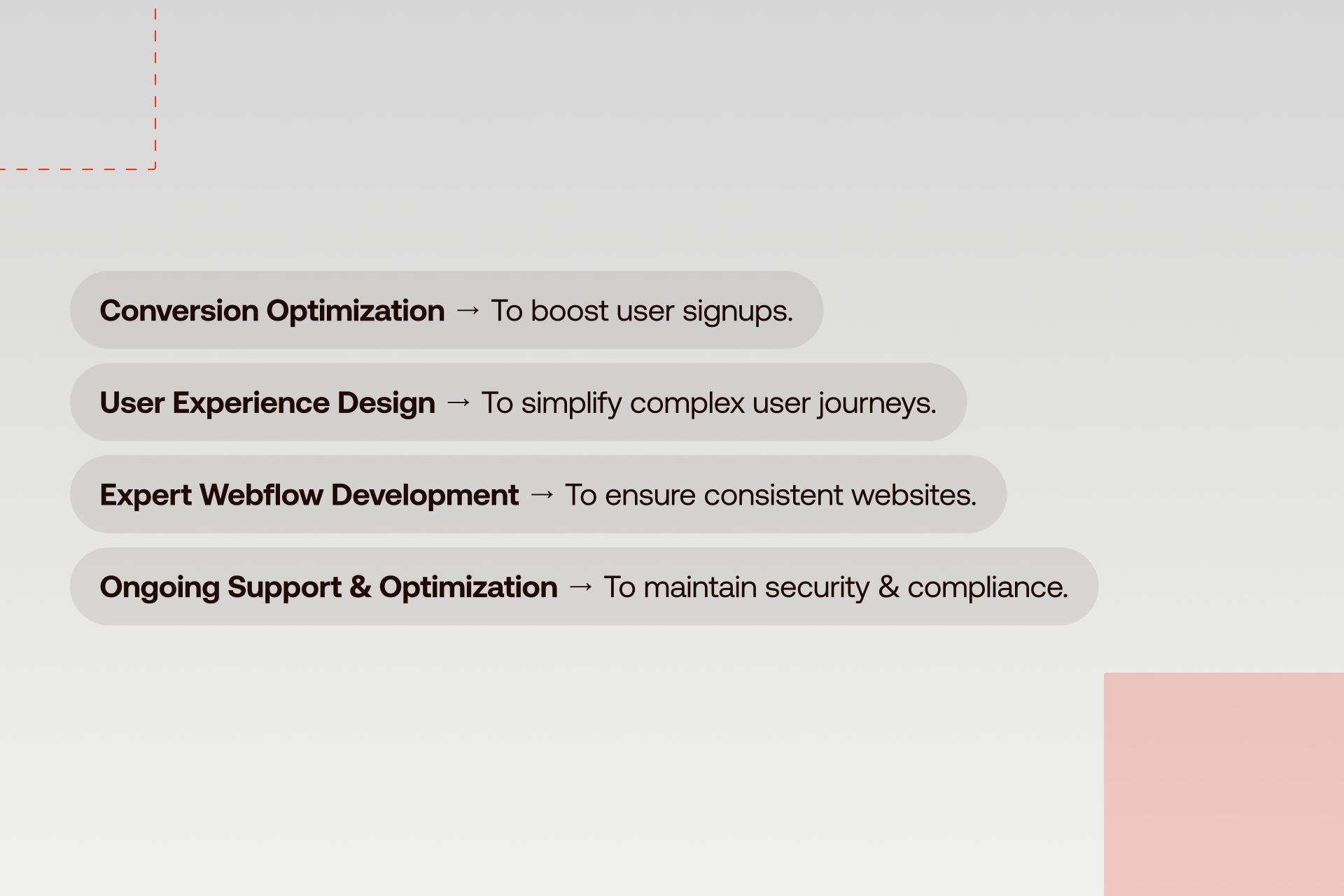
Design and development are important, but a specialized partner does more—they create a growth system that follows the strict rules of finance
Choose services that solve common fintech challenges, like building customer trust and handling technical integrations.
Fintech-Specific Design Services
The goal of fintech design is to turn complex financial concepts into intuitive digital experiences. This requires a focus on conversion and usability that goes deeper than surface-level aesthetics.
Conversion Optimization:
- Designing high-performance landing pages for user acquisition campaigns.
- Refining signup flows to reduce drop-off during sensitive data entry.
- Building trust-focused layouts that highlight security and social proof.
User Experience (UX) Design:
- Mapping customer journeys for complex products like lending or wealth management.
- Organizing information architecture to make dense data easy to navigate.
- Ensuring WCAG 2.1 AA accessibility compliance across all interactive elements.
Brand-Aligned Execution:
- Developing design systems in Webflow that maintain consistency across your marketing site and product platform.
- Translating sophisticated brand guidelines into a responsive, high-end web presence.
Webflow Development & Integration
Technical proficiency in this sector means building a website that is as secure and connected as the financial tools it promotes. Your Webflow partner should provide:
Full Webflow Development:
- Building custom, clean-coded websites from Figma or Sketch designs.
- Creating scalable CMS architectures for blogs, resource centers, and team directories.
- Implementing responsive design that works perfectly on every device.
Integration Services:
- CRM: Connecting forms to HubSpot or Salesforce for seamless lead management.
- Marketing Automation: Linking with tools like Marketo, Pardot, or Customer.io.
- Analytics: Setting up GA4, Segment, or Mixpanel to track the full user funnel.
- Customer Support: Integrating live chat and help desk tools without slowing down the site.
Technical Consultation:
- Assessing the feasibility of moving complex site structures to Webflow.
- Planning for migrations from legacy platforms like WordPress or Drupal.
Ongoing Support & Optimization
In regulated industries like fintech, a website is never truly "finished." It must keep evolving to meet market demands and follow changing regulations.
Ongoing support and optimization for fintech include:
- Performance Monitoring: Continuous checks of Core Web Vitals and page speed to ensure the site remains fast and reliable.
- Compliance Maintenance: Regularly auditing the site for accessibility issues and updating legal disclosures as regulations change.
- Security Reviews: Performing routine checks on third-party integrations and ensuring the site follows current security best practices.
- Marketing Support: Providing ongoing training for your internal team and building new landing pages for fast-moving marketing campaigns.
Top Webflow Experts for Fintech & Finance Websites (2026)
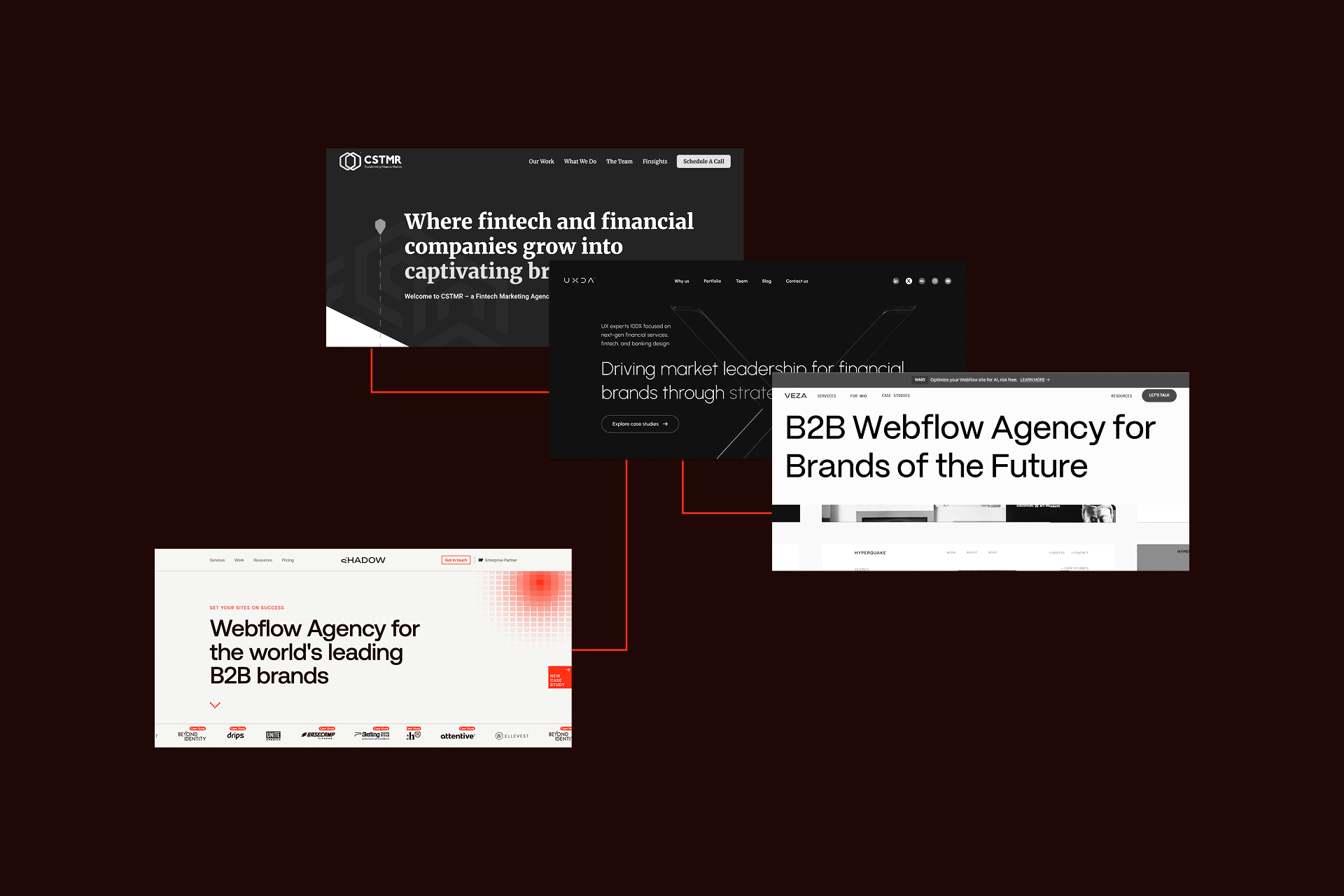
Shadow Digital ⭐ (Featured)
Overview:
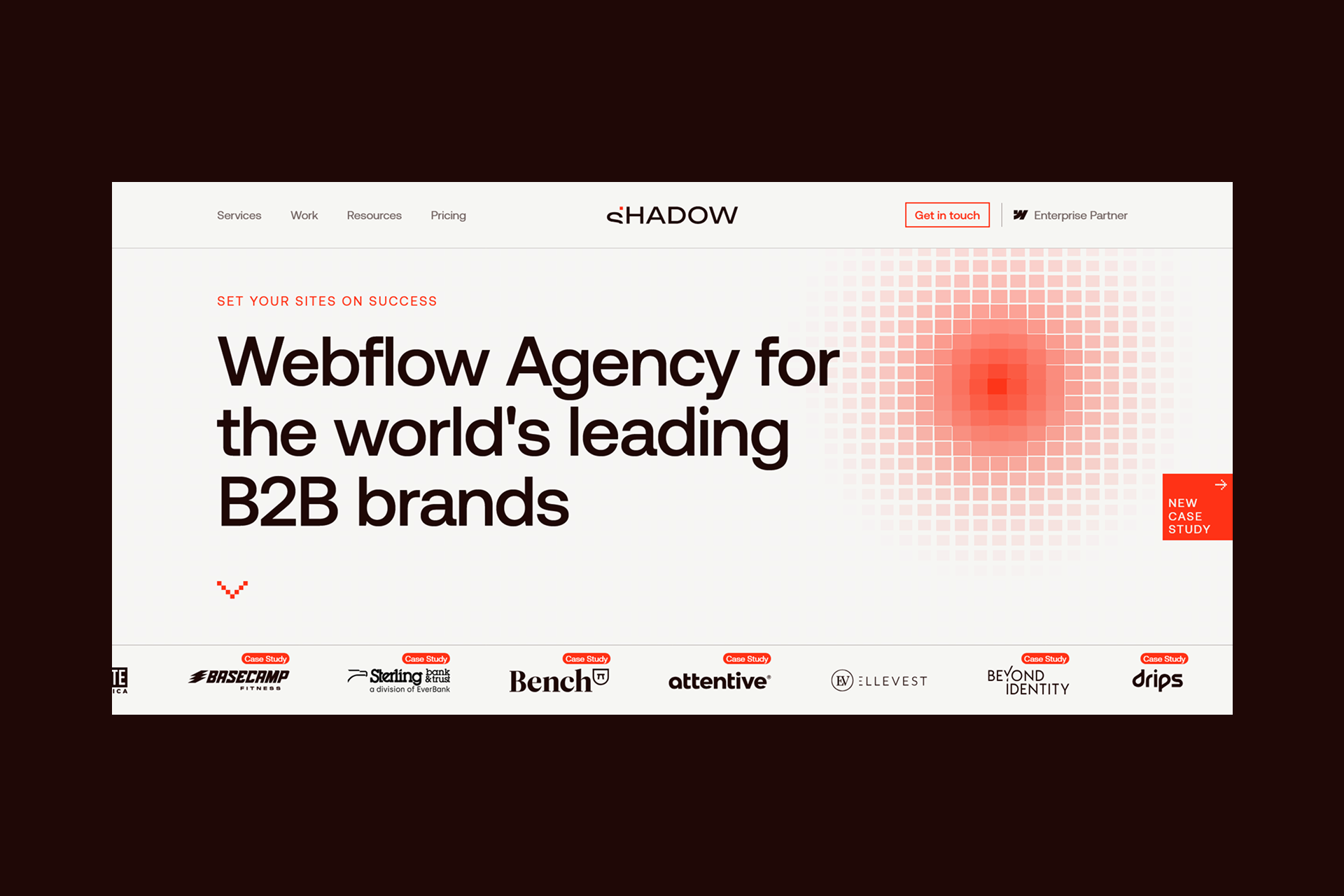
Shadow Digital is a Webflow Enterprise Partner. The agency focuses on important B2B and financial services websites, delivering expert fintech Webflow development. The Shadow team creates digital experiences for banks, fintechs, and regulated financial institutions, where trust, compliance, and performance are essential.
Fintech credentials:
- Official Webflow Enterprise Partner
- Named fintech and finance clients, including Sterling Bank and Bench (for more work check our Webflow portfolio)
- Extensive experience delivering results in regulated financial environments
Fintech-specific strengths:
- Trust-focused design methodology optimized for financial decision-making
- Compliance-aware development with strong accessibility and privacy standards
- Deep expertise in complex Webflow migrations
- Performance optimization to support credibility, SEO, and conversion
A notable example is Sterling Bank's major website migration. Shadow Digital preserved over 730 pages while improving the site's structure, accessibility, and performance—something few Webflow agencies can do.
Sterling Bank Case Study→
Bench Case Study→
Notable results:
Best for:
Banks, fintech startups, and B2B financial services firms requiring trust, regulatory awareness, and conversion-focused Webflow execution
Considerations:
Primarily B2B-focused; may not be ideal for consumer fintech products requiring deep product or in-app UX design
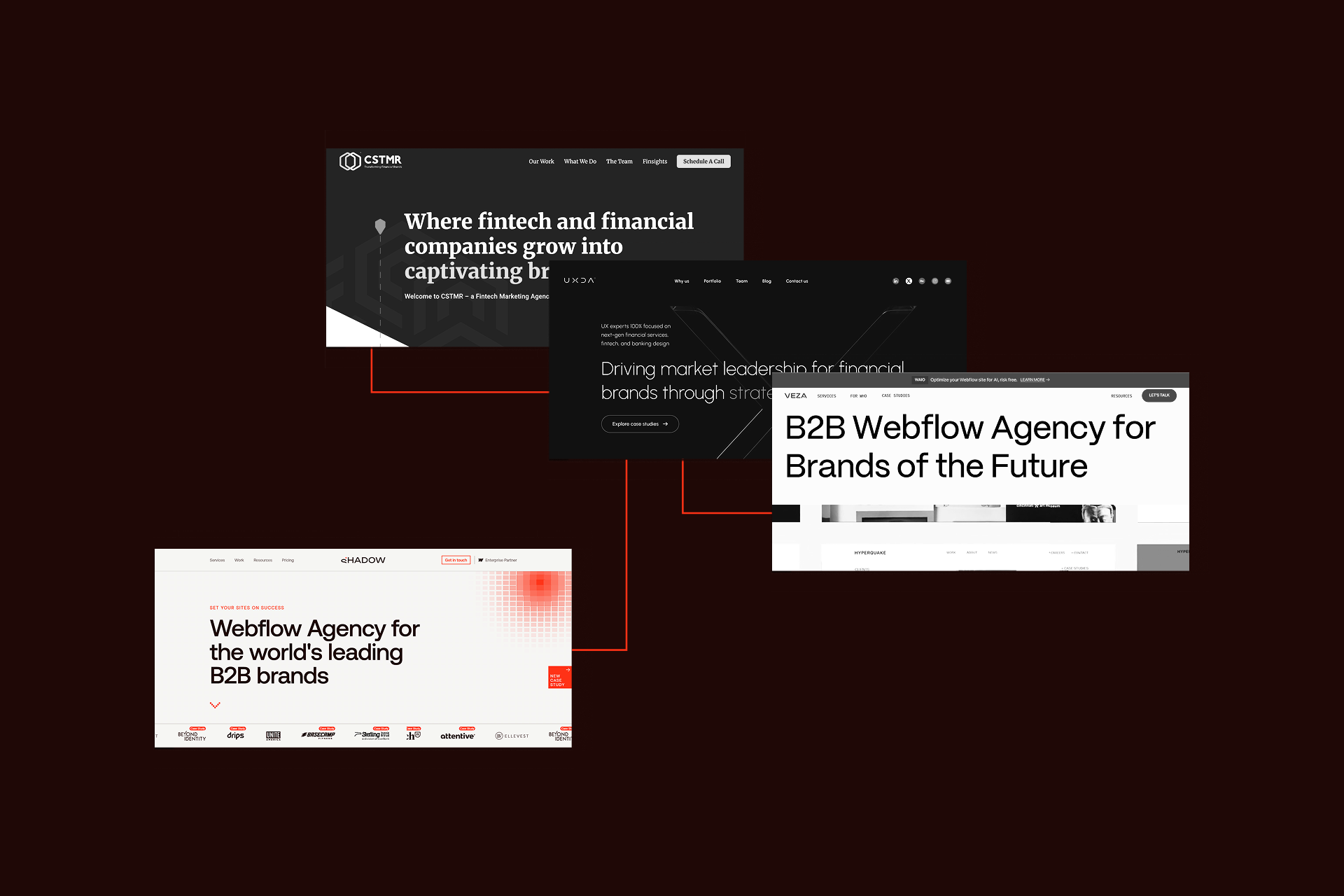
Veza Digital (Veza Agency Network)
Overview:
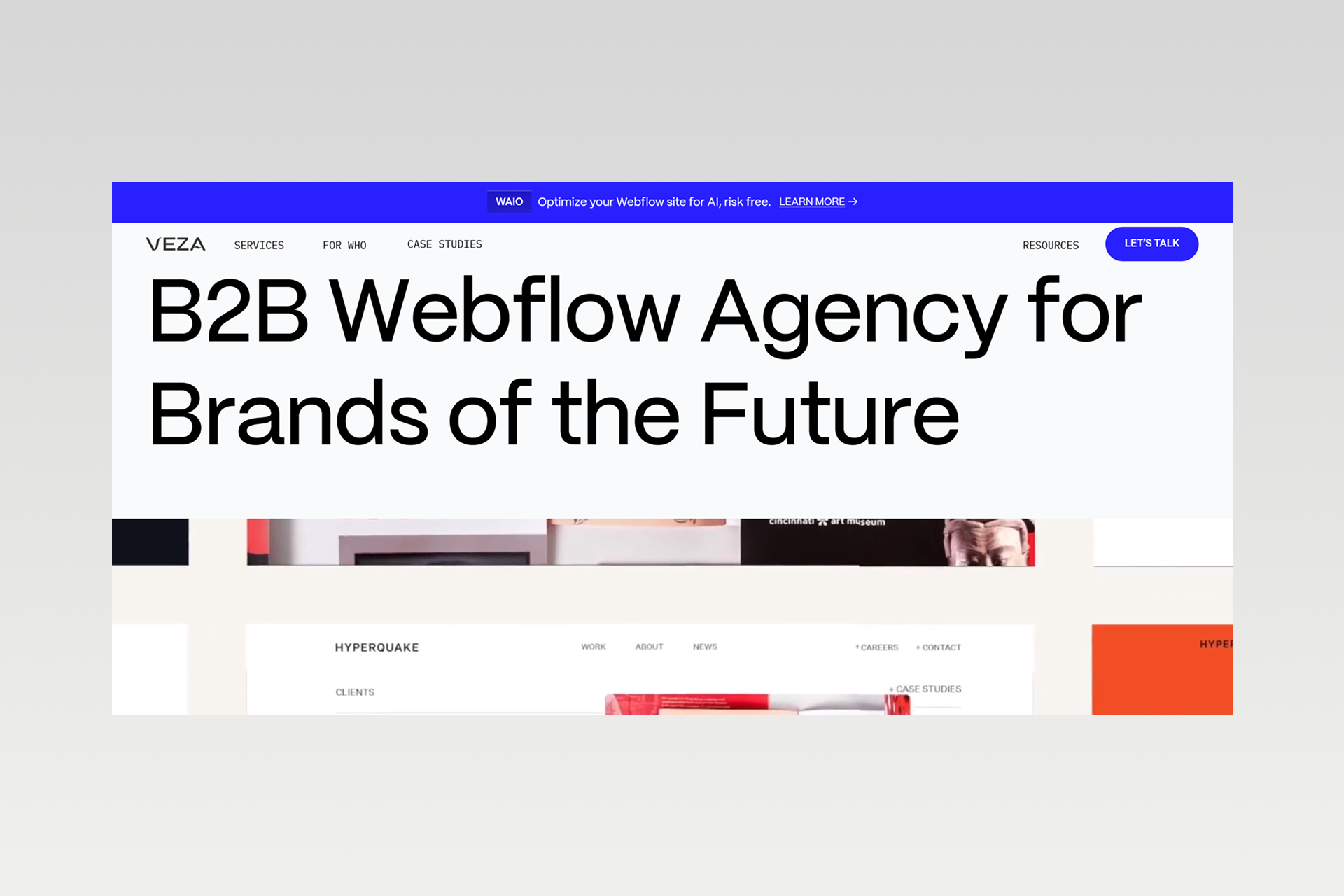
Veza Digital (Veza Agency Network) is a Webflow-focused B2B agency that delivers high-performance fintech and SaaS websites with a strong emphasis on technical SEO, scalability, and enterprise-grade execution.
Fintech credentials:
- Experience building fintech websites for B2B scaleups and enterprise teams
- Proven ability to translate complex financial offerings into clear, conversion-driven experiences
- Webflow expertise across enterprise builds, migrations, and integrations
Fintech-specific strengths:
- SEO-first fintech website methodology
- Performance-focused fintech Webflow development
- Accessibility-aware and security-conscious builds
- Conversion rate optimization for lead-driven fintech models
- Expertise in large-scale Webflow migrations and enterprise solutions
Notable results:
- Fintech website redesigns achieving up to 50% organic growth
- Improved lead quality and search visibility through technical SEO and CRO
- Enhanced brand clarity for complex fintech products
Best for:
B2B fintech companies prioritizing organic growth, search visibility, and scalable Webflow infrastructure
Considerations:
Broader B2B SaaS focus; not exclusively dedicated to fintech or consumer-facing financial apps
Additional Agencies with Fintech Experience
UXDA (User Experience Design Agency)
Overview:
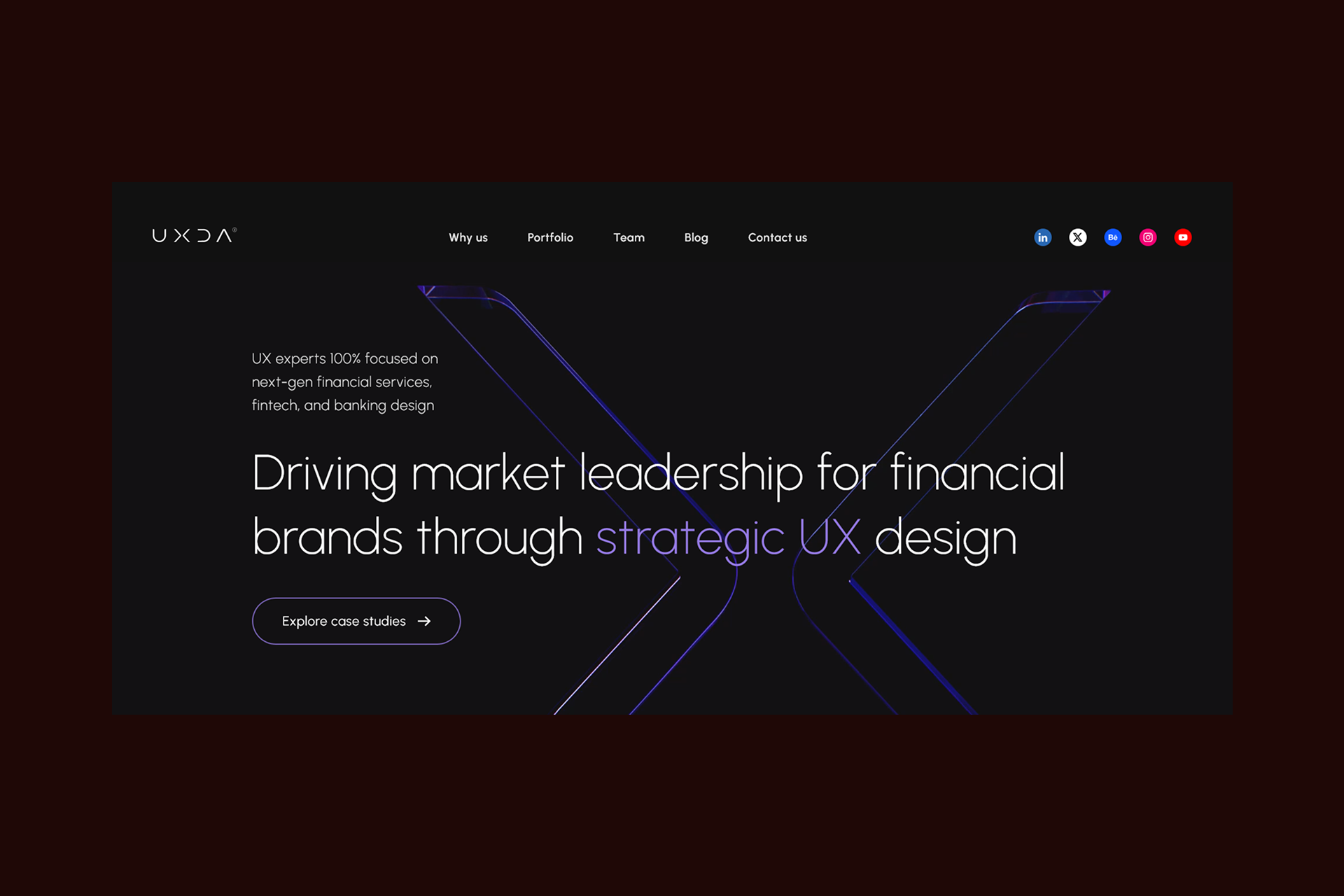
UXDA is a globally recognized fintech UX and design agency working exclusively with financial brands. With over a decade of experience and clients across 39+ countries, UXDA specializes in designing complex digital ecosystems for banks and fintech platforms.
Fintech credentials:
- 80+ financial brands served worldwide
- Team members with direct banking and financial operations experience
- 5-star ratings on Clutch and Google
Fintech-specific strengths:
- Deep financial UX strategy and human-centered design
- Brand-driven, non-templated design systems
- Expertise in complex financial products and ecosystems
- Innovation in AI banking and spatial banking concepts
Notable results:
- Up to 50% increase in product adoption
- Conversion improvements of up to 30% for financial institutions
Best for:
Established fintech companies and banks prioritizing UX leadership, brand differentiation, and complex financial platforms
Considerations:
Design- and strategy-led; less focused on Webflow-specific development execution
CSTMR (Fintech Marketing Agency)
Overview:
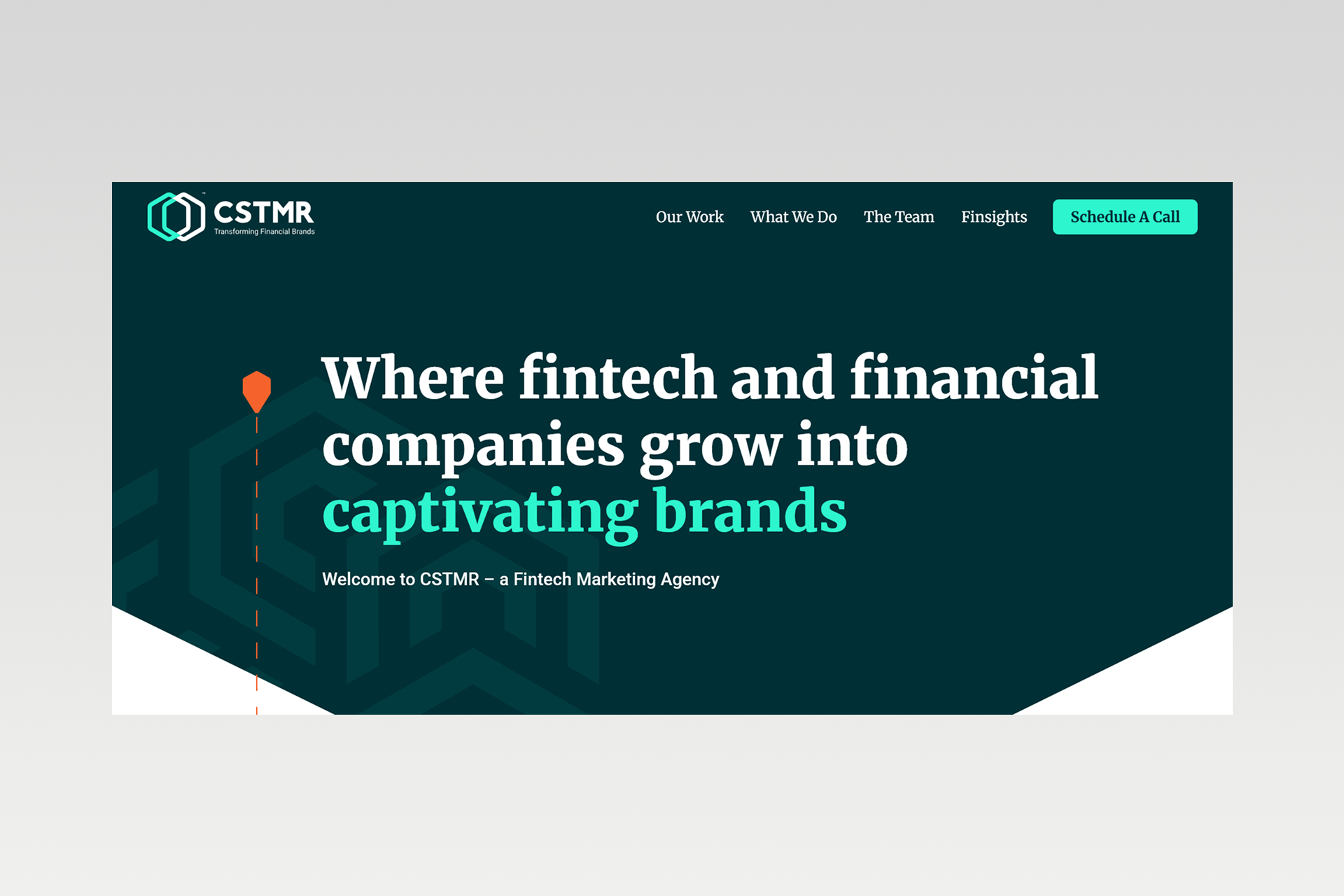
CSTMR is a fintech-focused marketing and digital experience agency serving companies across banking, payments, lending, insurance, credit, and investing. The agency combines branding, marketing strategy, and digital execution to support fintech growth at every stage.
Fintech credentials:
- Works exclusively within financial services and fintech
- Experience across traditional finance and emerging fintech models
- Deep understanding of regulated financial marketing environments
Fintech-specific strengths:
- Fintech branding and positioning
- Performance marketing and discovery optimization (SEO/AI)
- Web and app experience design aligned with trust and compliance
- Go-to-market and scale-up expertise for fintech launches
Notable results:
- Proven success supporting fintech launches, rebrands, and growth initiatives
- Integrated brand + performance strategies tied to measurable revenue impact
Best for:
Fintech companies seeking integrated marketing, branding, and web experience support
Considerations:
Marketing-led agency; not Webflow- or development-centric
Evaluating Fintech Webflow Experts: What to Look For
When you begin your outreach, use a critical eye. A "pretty" site isn't enough in finance.
You want to check:
- Portfolio Review: Do they have at least three named fintech clients? Anonymous "finance concepts" are a red flag. Look for case studies that mention real growth metrics or compliance wins.
- Compliance Fluency: Ask them to explain their process for ensuring WCAG 2.1 AA accessibility. If they can't speak to it clearly, they aren't ready for the finance sector.
- Trust Indicators: Look for official Webflow Enterprise Partner status or industry awards from recognized platforms like Awwwards or Clutch. These suggest a level of professionalism that minimizes your project risk.
Fintech Webflow Expert Evaluation Scorecard
Choosing the Right Fintech Webflow Partner
The search for a partner is less about finding a vendor and more about finding a technical extension of your team. In a field as fast-moving and sensitive as finance, the wrong choice can lead to more than just a late launch; it can lead to regulatory friction or a loss of user confidence.
Key Factors to Consider
When you begin narrowing down your list, look for a balance between industry knowledge and technical depth.
Industry Fit:
Does the agency understand your specific slice of finance? A team that has built for B2B neobanks will have a different perspective than one focused on consumer crypto apps.
The right partner should show understanding of your regulatory environment and the specific "trust hurdles" your customers face.
Technical Fit:
Fintech sites often require more than just static pages. Can the partner handle complex integrations with your existing tech stack, such as connecting to a custom banking API or a sophisticated CRM?
A fintech partner must prove they can meet high performance standards, specifically Core Web Vitals, to ensure the site feels fast and secure.
Business Fit:
Beyond the code, look for a match in culture and scale. Their pricing should align with the value they provide, and their delivery timelines must be realistic.
A partner who promises a complex, compliant site in two weeks is likely cutting corners on the very things—like accessibility audits—that protect your business.
Questions to Ask During Consultation
The initial meeting is your chance to evaluate the team's approach and problem-solving capabilities. Use these targeted questions to separate specialists from generalists.
Experience & Credibility:
- "How many financial services websites have you successfully launched in the last year?"
- "Can you walk me through a project where you had to manage strict regulatory disclosures or accessibility requirements?"
- "Can we speak with a fintech client reference who had a similar scope to ours?"
Process & Security:
- "What is your specific workflow for ensuring WCAG 2.1 AA accessibility compliance?"
- "How do you handle the handoff of sensitive lead data from Webflow forms to our backend or CRM?"
- "Who specifically will be the lead developer on our project, and what is their experience with finance builds?"
Building a Long-Term Partnership
In fintech, a website is never truly finished. Rules change, security risks appear, and the market shifts. A good partner stays with you after launch.
Choose a team that offers ongoing Webflow support. They can monitor your site, keep integrations running, and help launch new pages. A long-term partner ensures your website grows with your business and keeps your users’ trust.
Conclusion: Finding Your Fintech Webflow Expert
Building a website in the financial sector is high-stakes. Your site connects users to their bank accounts, so it must be exceptional. Success needs a partner who focuses on the three pillars of fintech: trust, compliance, and conversion optimization.
Webflow skills alone aren’t enough. You need a team that understands regulatory rules, fast load times, and accessibility. Check their portfolio for financial clients and measurable results.
At Shadow Digital, we’ve helped Sterling Bank, Bench, and many growing fintech startups. We know what this industry needs, from secure hosting to designs that turn visitors into clients.
We find the right fit for your growth stage. Whether you’re a neobank launching soon or a B2B financial tool expanding content, the right partner makes a difference.
Ready to discuss your fintech website? Schedule a consultation. We’ll help you see if Shadow Digital is the right match, or point you to the best option if not.
FAQ – Frequently Asked Questions
Finding Experts
What should I look for in a Webflow expert for fintech?
Prioritize three things: proven fintech experience, strong technical execution, and security awareness. Look for named fintech clients, measurable results, clean scalable frameworks, and a clear understanding of trust signals, accessibility, and regulatory disclosures.
How do I find Webflow agencies with fintech experience?
Start with the Webflow Experts directory and filter for Enterprise Partners or Financial Services. Check fintech site footers, Clutch reviews from fintech founders, and real case studies with live URLs, not concept work.
Do I need a specialized fintech Webflow agency?
Yes. Fintech specialists understand trust, accessibility (WCAG), and data privacy requirements that general agencies often miss. They reduce risk, speed up delivery, and build sites that can pass legal and security reviews.
Fintech-Specific
What makes fintech website design different?
Fintech design is about trust. Every visual, interaction, and load time signals legitimacy. Sites must balance conversion goals with regulatory disclosures, accessibility, and a “stable, permanent” feel.
How do Webflow experts handle financial compliance?
They design with compliance first, WCAG 2.1 AA accessibility, GDPR/CCPA privacy controls, structured CMS for disclosures, and SOC 2–compliant hosting via Webflow Enterprise.
Can Webflow handle the security needs of fintech websites?
Yes. Webflow offers SSL, DDoS protection, and SOC 2 Type II compliance. It’s more secure than plugin-based CMSs and keeps sensitive financial data off the marketing site via secure APIs.
Project Scope
How much does a fintech Webflow website cost?
Most fintech projects range from $15,000–$50,000+. Higher budgets cover migrations, SEO, accessibility audits, custom tools, and complex integrations.
How long does it take to build a fintech website in Webflow?
Typically 8-12 weeks, including discovery, design, development, QA, accessibility checks, and SEO setup. Regulated migrations take longer by necessity.
What integrations do fintech Webflow websites typically need?
Common integrations include Plaid or MX, Stripe or Adyen, KYC tools like Onfido, CRMs like HubSpot or Salesforce, analytics tools, and real-time financial data APIs.
Working Together
What questions should I ask a fintech Webflow agency?
Ask how they handle compliance, SEO migrations, complex integrations, and post-launch updates, especially rapid legal or disclosure changes.
How do I evaluate a Webflow agency's fintech experience?
Review live fintech sites, check performance scores, look for measurable results in case studies, and speak directly with past fintech clients.
What ongoing support do fintech websites need?
Regular accessibility checks, security reviews, performance monitoring, and fast updates for disclosures, campaigns, and growth experiments.