Umbraco vs Sitecore 2026: Which .NET CMS is right for your organisation?

Let's Build Your Webflow Website!
Partner with experts who understand your vision. Let’s create a converting user experience and build your website for future growth.
Umbraco and Sitecore share a technology foundation. Both run on .NET. Both have strong developer communities in the Microsoft ecosystem. Beyond that, they are solving different problems for different organisations at very different price points.
Umbraco is open-source, flexible, and accessible to a wide range of teams and budgets. Sitecore is a proprietary enterprise DXP with a price tag and complexity to match. The organisations that get this decision wrong are usually the ones that buy Sitecore when they needed Umbraco, not the other way around.
Here is what the comparison actually looks like.
What you are choosing between
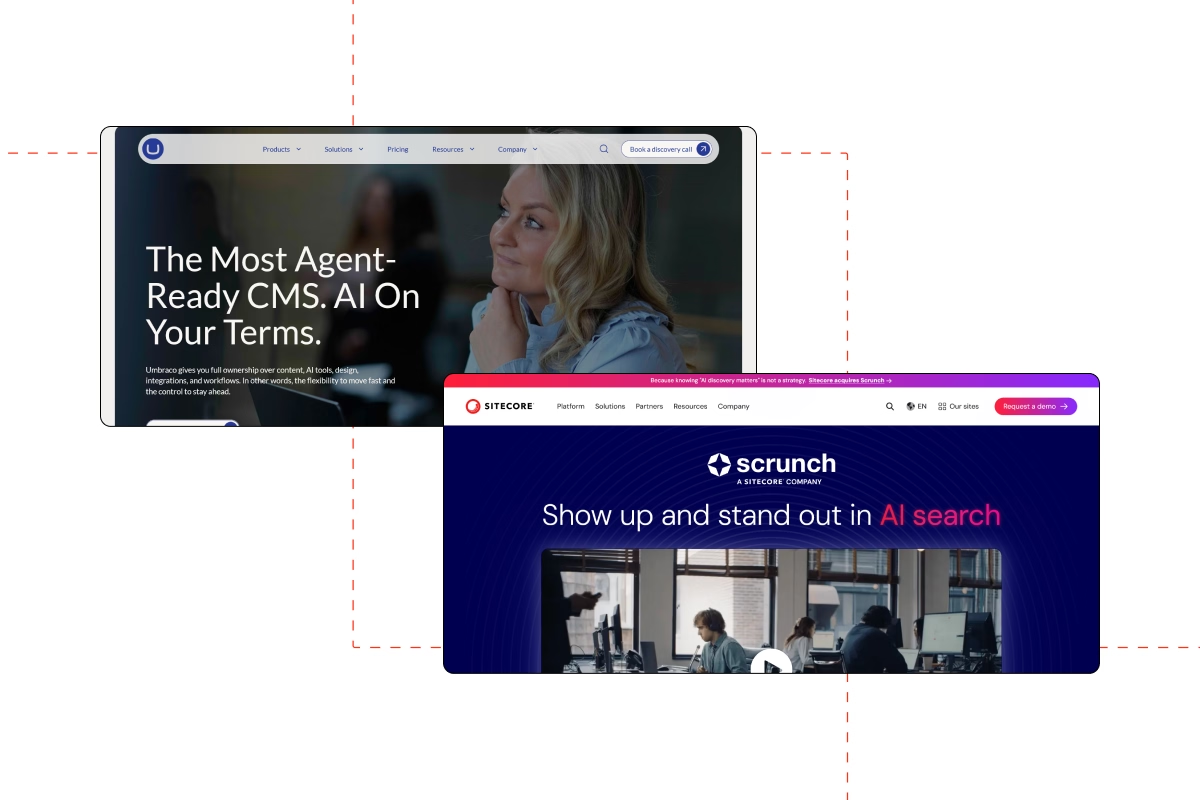
Umbraco is an open-source .NET CMS that has been in active development since 2005. It is free to download and use. The platform is built on ASP.NET Core, which means any .NET developer can work with it without specialist certification. Umbraco Cloud is the managed hosting option, starting at around £40-50 per month for small sites and scaling to enterprise plans. The community is large and active. The package ecosystem covers most standard requirements.
Sitecore is a proprietary Digital Experience Platform built on .NET. Sitecore XM Cloud is the current cloud-native offering. It integrates with Sitecore's broader product portfolio: Sitecore CDP, Sitecore Personalize, Sitecore Search, and Sitecore OrderCloud. It is not a CMS you install and configure independently. It is a platform you procure through an enterprise contract, implement with certified partners, and staff with specialist developers.
Both run on .NET. The similarity ends there.
Head-to-head comparison
Pricing and total cost of ownership
Umbraco core is free. Umbraco Cloud managed hosting runs £40-200 per month for smaller sites. Enterprise-scale Umbraco Cloud deployments run £500-2,000+ per month depending on traffic, storage, and support requirements. Implementation costs for a well-built Umbraco site run £15,000-100,000 depending on complexity. Any competent .NET developer can maintain it, at standard market rates.
Sitecore XM Cloud licensing starts at roughly $60,000-100,000 per year for smaller enterprise deployments. Full deployments with CDP and Personalize integration run $200,000-500,000+ per year. Implementation with a certified Sitecore partner costs £150,000-600,000. Ongoing development requires .NET developers with Sitecore-specific certification, who are in short supply and charge accordingly.
The three-year total cost of ownership gap between a comparable Umbraco and Sitecore deployment is typically measured in hundreds of thousands of pounds.
Figures are indicative ranges based on mid-2026 market rates. Verify with vendors and implementation partners.
Ease of use and authoring experience
Umbraco's back-office interface is clean and manageable for non-technical content editors. The document type and property editor system is flexible enough for developers to build exactly the editing experience the content team needs. Training a content team on Umbraco takes days. The interface does not get in the way.
Sitecore's authoring experience has improved in recent versions. The Pages interface in XM Cloud is more polished than earlier iterations. But the underlying DXP complexity means content operations require more structured workflows and more training than Umbraco. For large organisations with dedicated digital operations teams, this is workable. For leaner teams, it creates dependency on specialist support for routine content tasks.
Umbraco wins on authoring accessibility for most teams.
Customisation and development flexibility
Umbraco's open-source architecture gives developers genuine freedom. The content modelling system is flexible. The package ecosystem covers standard requirements. Custom development follows standard ASP.NET Core patterns, which means any competent .NET developer can contribute without platform-specific training. The codebase is readable, well-documented, and actively maintained by the community.
Sitecore's customisation follows the platform's opinionated architecture. Deep customisation is possible but requires familiarity with Sitecore's specific patterns, pipelines, and data templates. Every customisation needs a developer who understands the Sitecore way of doing things, not just .NET generally. This narrows the available talent pool and increases both build and maintenance costs.
For development teams, Umbraco offers more freedom at lower cost. Sitecore offers more pre-built enterprise capability at significantly higher cost and complexity.
Scalability and performance
Umbraco scales well when the build and infrastructure are right. Large government portals, retail sites, and media properties run on Umbraco without issues. Umbraco Cloud handles infrastructure scaling automatically on managed plans. For self-hosted deployments, standard .NET hosting infrastructure applies.
Sitecore XM Cloud's SaaS model handles infrastructure scaling as part of the contract. For organisations managing dozens of sites across multiple regions with complex content governance, Sitecore's native multi-site architecture handles that more cleanly than Umbraco's multi-site setup, which requires more custom configuration at scale.
For most organisations, Umbraco scales to their actual requirements. Sitecore's scalability advantage is real but relevant primarily at global enterprise scale.
Personalisation and marketing features
Sitecore's native personalisation stack (XM Cloud plus Sitecore CDP and Sitecore Personalize) is a genuine differentiator. Rule-based and AI-driven personalisation, A/B testing, and audience segmentation work across the stack within a single vendor relationship. For organisations running sophisticated multi-channel personalisation programmes, this is the strongest argument for Sitecore.
Umbraco does not have a native personalisation engine at this level. Personalisation in Umbraco is built through third-party integrations: tools like Optimizely, Segment, or HubSpot connected via API. It is achievable, but it requires assembling capability from multiple vendors rather than using a single pre-integrated stack.
The honest question, as with any enterprise DXP evaluation, is whether your organisation is actively running personalisation programmes at a level that justifies Sitecore's cost. If the answer is yes, Sitecore's native stack is a real advantage. If the answer is no, you are paying for capability that will sit unused.
Security and compliance
Both platforms operate on .NET, which has a strong enterprise security track record. Umbraco's security team actively monitors and patches vulnerabilities. The open-source nature means security issues are publicly disclosed and fixed quickly. GDPR and standard compliance requirements are achievable with proper configuration.
Sitecore's enterprise support contract provides a clearer accountability chain for regulated industries where formal security audit documentation is required. SOC 2 compliance, detailed security certifications, and dedicated security support are part of the enterprise contract in a way that Umbraco's community model does not replicate.
For organisations in regulated sectors where compliance documentation is a procurement requirement, Sitecore's credentials simplify the audit process. For organisations where standard security practice is sufficient, Umbraco's track record is strong. The best healthcare website design examples show how compliance-heavy organisations approach platform selection, and the underlying security question applies directly here. Similarly, the best banking website design examples illustrate how financial services organisations factor platform compliance credentials into the decision.
Community, support, and ecosystem
Umbraco has a large and active open-source community. The Umbraco forum, the Our Umbraco community platform, and a wide network of certified partners provide support and resources. The package ecosystem covers most standard requirements. Community support is responsive and high quality for a free platform.
Sitecore's support comes through the enterprise contract and certified partner network. The Sitecore community is smaller than Umbraco's but more commercially structured. Dedicated account management, SLAs, and certified implementation partners provide a formal support chain that the community model does not.
For organisations that need contractual support obligations, Sitecore provides them. For organisations comfortable with community-based support supplemented by a .NET development team, Umbraco's ecosystem is more than adequate.
Pros and cons
Umbraco
Strengths: No licensing cost. Wide .NET developer availability. Clean, flexible content modelling. Accessible authoring interface. Strong open-source community. Fast to build and deploy. Managed cloud hosting option. Low total cost of ownership.
Weaknesses: No native personalisation engine. Multi-site governance at true enterprise scale requires custom configuration. Community support model lacks formal SLAs. Less pre-built marketing automation than Sitecore.
Sitecore
Strengths: Native personalisation and CDP integration. Strong multi-site governance. Formal enterprise support and SLAs. Cloud-native SaaS delivery with XM Cloud. Pre-built marketing automation capability. Compliance credentials for regulated industries.
Weaknesses: Very high licensing and implementation cost. Specialist certified developers required. Long implementation timelines. Significant capability often goes unused. Vendor lock-in is a real risk. Overkill for most organisations outside global enterprise.
Who should choose what
Choose Umbraco if:
- Platform budget is under £50,000 per year
- Your team includes .NET developers or you work with agencies that do
- Content editors need an accessible interface without extensive training
- You need flexible content modelling without proprietary constraints
- Personalisation is not a core, actively used marketing programme
- You want freedom to build a composable or headless architecture without vendor lock-in
- You are an agency building multiple client sites on a .NET stack
Choose Sitecore if:
- You are a large enterprise with a platform budget above £150,000 per year
- Multi-channel personalisation is a genuine, actively managed marketing programme
- You manage multiple brands or sites across multiple regions with complex governance requirements
- You need formal enterprise support contracts and SLAs for internal or regulatory compliance
- You are already invested in a broader Sitecore product ecosystem
Migration from Sitecore to Umbraco
This is the more common direction. Organisations that have paid for Sitecore's enterprise capability without fully using it move to Umbraco to reduce cost and regain developer flexibility.
The migration involves exporting content from Sitecore's content tree, remapping to Umbraco's document types and property structure, rebuilding templates in ASP.NET Core, reconnecting integrations, and managing redirects for SEO preservation. A complex migration typically takes three to six months. Simpler sites move faster.
The cost saving is often immediate and significant. Licensing fees stop. Developer rates normalise. Maintenance overhead reduces. For organisations not actively using Sitecore's DXP capabilities, the migration ROI is usually positive within the first year.
The web development trends toward composable and headless architecture are worth reviewing before scoping any migration, because the build approach matters as much as the platform choice.
Comparison tables
Feature matrix
Use case suitability
The Webflow consideration
For B2B marketing sites specifically, neither Umbraco nor Sitecore is always the right answer. Umbraco is a strong CMS for content-heavy and custom .NET builds. Sitecore is built for enterprise DXP requirements. A focused B2B marketing site primarily needs to generate pipeline, load fast, and be manageable by a non-technical team.
Webflow handles that use case well, often more efficiently than a custom .NET build. Our Webflow development and design capability covers what that looks like for B2B organisations. For teams on Umbraco or Sitecore evaluating whether Webflow fits their marketing site requirements, Webflow migration is a well-defined process for most marketing site scopes.
FAQs
What are the main differences between Umbraco and Sitecore?
Umbraco is free open-source .NET CMS with wide developer availability and flexible content modelling. Sitecore is a proprietary enterprise DXP with native personalisation, formal enterprise support, and a licensing cost that starts at $60,000-100,000 per year. The cost gap and capability scope are both significant.
How does pricing compare?
Umbraco is free to use. Sitecore licensing starts at $60,000-100,000 per year. The three-year total cost of ownership gap between comparable deployments typically runs into hundreds of thousands of pounds.
Which is better for developers?
Umbraco. The open-source ASP.NET Core architecture means any .NET developer can contribute without platform-specific certification. Sitecore requires specialist certified developers who are in short supply and charge premium rates.
Can Umbraco handle enterprise-level projects?
Yes, with the right build and infrastructure. Large government portals, retail sites, and complex content platforms run on Umbraco. The limitation is native DXP capability, specifically personalisation and multi-site governance at global scale, not raw technical capacity.
Is it easy to migrate from Sitecore to Umbraco?
It is manageable with proper planning. Content remapping, template rebuilding, integration reconnection, and redirect management are the main workstreams. A complex migration takes three to six months. The licensing cost saving typically makes the investment worthwhile within the first year.
Which has better community support?
Umbraco. The open-source community is large, active, and responsive. Sitecore's support is more commercially structured through its partner network and enterprise contracts, which provides formal SLAs but less organic community resource.
To see how we approach platform decisions on real B2B builds, including when neither platform fits the brief, our work shows the thinking behind the recommendation.
A note on sources
Pricing figures in this article are indicative ranges based on publicly available information and mid-2026 market rates. Sitecore pricing is negotiated on enterprise contracts and varies by scope and region. Umbraco Cloud pricing is published at umbraco.com and subject to change. Verify current pricing directly with each vendor before making a procurement decision.
Platform capability descriptions reflect Umbraco 11 and Sitecore XM Cloud as of June 2026. Both platforms update regularly. Verify current features at umbraco.com and sitecore.com.
TCO estimates are indicative and consistent with ranges cited in earlier Shadow Digital CMS comparison articles in this series.