Sitecore vs AEM 2026: Which enterprise DXP is right for your organisation?

Let's Build Your Webflow Website!
Partner with experts who understand your vision. Let’s create a converting user experience and build your website for future growth.
Both Sitecore and Adobe Experience Manager are expensive, complex, and built for organisations with the budget and team to use them properly. The question is not which one is better. The question is which one fits your specific situation, and whether either of them is the right call at all.
Most organisations that end up in a Sitecore vs AEM evaluation are large enterprises with real requirements for personalisation, multi-site governance, and marketing automation at scale. If that describes you, this comparison gives you what you need to make the call. If you are a mid-size organisation that wandered into this comparison after a vendor pitch, the honest answer is probably neither.
What you are choosing between
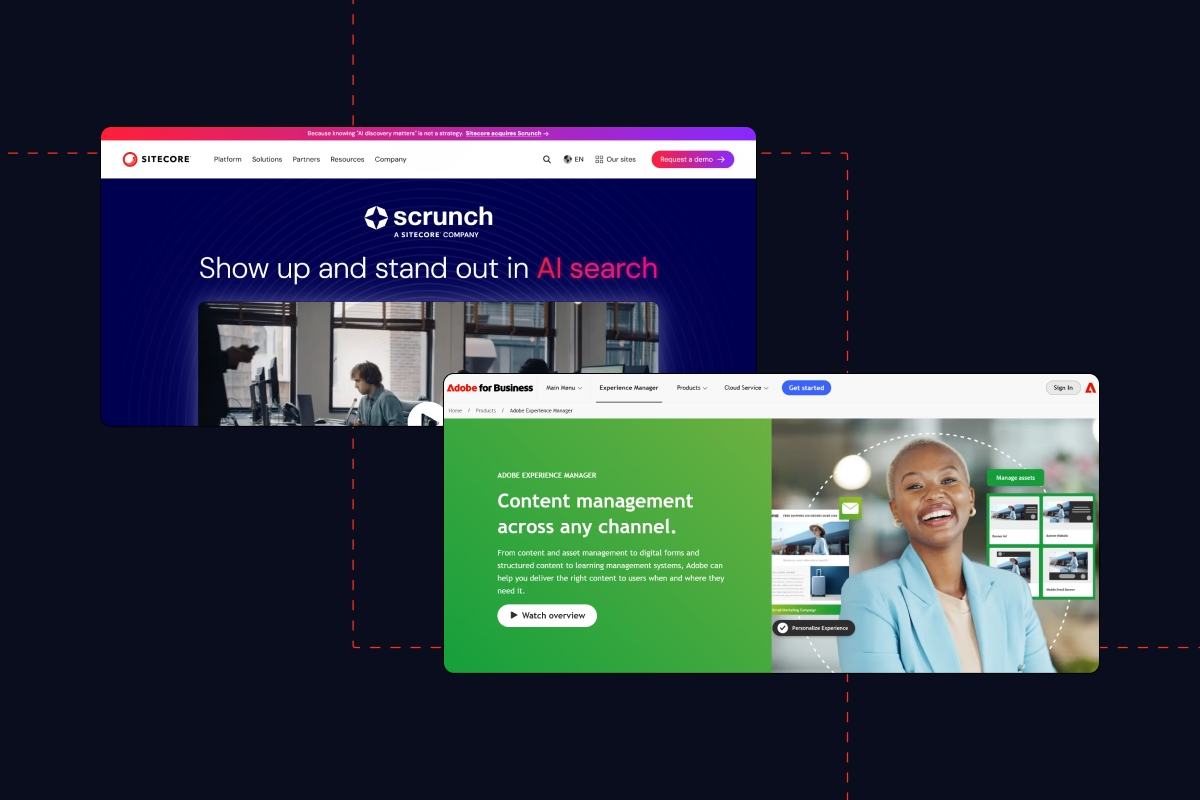
Sitecore is a .NET-based Digital Experience Platform. Sitecore XM Cloud, the current cloud-native iteration, moves the platform away from on-premise toward a SaaS delivery model. It integrates with Sitecore's broader product suite: Sitecore CDP, Sitecore Personalize, Sitecore Search, and Sitecore OrderCloud for commerce. The platform's core strength is personalisation and marketing automation, built natively into the architecture rather than bolted on through integrations.
Adobe Experience Manager is a Java-based DXP built on the Apache Jackrabbit content repository. AEM as a Cloud Service is Adobe's current cloud-native offering. It integrates with Adobe Experience Cloud: Adobe Analytics, Adobe Target, Adobe Campaign, Adobe Commerce, and Marketo. The platform's core strength is its position inside the Adobe ecosystem and its native Digital Asset Management capability through AEM Assets.
The architectural difference matters in practice. Sitecore runs on .NET, which means your implementation and ongoing development team needs .NET expertise. AEM runs on Java, which means your team needs Java expertise, specifically with AEM's HTL templating language and its JCR content model. Both talent pools are specialist and expensive. Neither is abundant.
Head-to-head comparison
Pricing and total cost of ownership
Neither platform publishes pricing. Both are sold through enterprise contracts with negotiated terms.
Sitecore XM Cloud licensing typically starts at $60,000-100,000 per year for smaller enterprise deployments. Larger contracts with full CDP and Personalize integration run $200,000-500,000+ per year. Implementation with a certified Sitecore partner costs £150,000-600,000 for a full deployment. Ongoing support and development require .NET developers with Sitecore certification.
AEM as a Cloud Service licensing starts higher. Most enterprise contracts run $250,000-600,000 per year, scaling to $1,000,000+ for large global deployments with full Adobe Experience Cloud integration. Implementation costs run £200,000-800,000+. Ongoing development requires Java developers with AEM-specific experience.
The total cost of ownership gap over three years is meaningful. AEM is generally more expensive than Sitecore at equivalent scale, primarily because of higher licensing costs and a smaller, more expensive developer talent pool.
Figures are indicative ranges based on mid-2026 market rates. Verify with vendors and implementation partners.
Content authoring and user experience
Sitecore's Experience Editor and the newer Pages interface in XM Cloud have improved significantly. The authoring experience is visual, and non-technical content teams can manage day-to-day content operations without developer involvement once the templates are built. The workflow and approval system is strong for organisations with governance requirements.
AEM's authoring interface has a steeper learning curve. The Touch UI is more approachable than the Classic UI it replaced, but AEM's underlying complexity means content authors need more training and ongoing support than on Sitecore. For large organisations with dedicated digital operations teams, this is manageable. For leaner teams, it is a real operational burden.
On authoring experience, Sitecore has the edge for most content teams.
Personalisation and marketing capabilities
This is the core of the comparison for most organisations evaluating both platforms.
Sitecore's native personalisation stack (XM Cloud plus Sitecore CDP and Sitecore Personalize) operates as a connected system. Behavioural data from the CDP feeds personalisation rules in XM Cloud. A/B and multivariate testing runs through Sitecore Personalize. The entire flow is managed within a single vendor relationship. For organisations with dedicated digital marketing teams running active personalisation programmes, this is a meaningful operational advantage.
AEM's personalisation story runs through Adobe Target, which integrates tightly with AEM and Adobe Analytics. The combination is powerful, particularly for organisations already running Adobe Analytics and with data science teams that can use the full capability of Target's AI-driven optimisation. The trade-off is that the capability is spread across multiple products, each with their own contracts and teams.
For organisations already committed to the Adobe Experience Cloud, AEM's personalisation story is strong because the integration is pre-built. For organisations not already in the Adobe ecosystem, Sitecore's native stack is simpler to implement and manage.
Scalability and multi-site management
Both platforms are built for global enterprise scale. The question is where each excels.
Sitecore XM Cloud handles multi-site management well, with content sharing, inheritance models, and language variants across sites all manageable from a central interface. The cloud-native architecture removes the infrastructure management burden that earlier on-premise Sitecore versions required.
AEM's multi-site management (MSM) is its strongest feature in this category. The Live Copy and Blueprint model allows sophisticated content inheritance across dozens of sites, regional variants, and brand hierarchies. For global organisations managing many brands across many markets, AEM's MSM is arguably the most capable in the enterprise DXP market.
For organisations managing large, complex multi-brand and multi-region site portfolios, AEM has the advantage here. The web development trends toward composable architecture are relevant to both platforms: both Sitecore XM Cloud and AEM as a Cloud Service support headless and composable deployment models, which changes how multi-site management works in practice.
Security, compliance, and governance
Both platforms operate at enterprise security standards. AEM's Java architecture on Adobe's cloud infrastructure has a strong compliance track record, particularly for organisations in regulated industries. SOC 2, GDPR, and HIPAA-aligned configurations are available on both platforms, though the certification and documentation process is typically more straightforward with AEM's enterprise support model.
For organisations in financial services and healthcare where compliance documentation is a procurement requirement, both platforms satisfy the requirement. AEM's advantage is the depth of Adobe's compliance infrastructure and the breadth of certifications available.
For organisations in highly regulated sectors, the best healthcare website design examples and best banking website design examples both illustrate how platform decisions intersect with compliance requirements in practice, and the DXP choice sits underneath all of it.
AI features and future readiness
Both platforms are integrating AI capability, with different approaches.
Sitecore's AI features are built around content generation assistance, personalisation optimisation through Sitecore Personalize, and search relevance through Sitecore Search. The roadmap points toward more AI-driven audience segmentation and content recommendations within the existing product stack.
AEM's AI story runs through Adobe Firefly and Adobe Sensei. Firefly integration brings generative AI into the content creation workflow directly: image generation, text variations, and content remixing within AEM Assets and AEM Sites. For organisations with high-volume content production needs, this is a meaningful capability.
On AI, AEM's integration of Firefly gives it a more visible near-term advantage, particularly for content production at scale.
Pros and cons
Sitecore
Strengths: Native personalisation stack with CDP integration. Stronger authoring experience than AEM. .NET architecture fits organisations already on Microsoft stack. XM Cloud's SaaS model removes infrastructure management. Cleaner single-vendor relationship for personalisation and content.
Weaknesses: High licensing and implementation cost. .NET specialist developers required. Smaller developer community than AEM. Less capable DAM than AEM Assets. Multi-site management not as strong as AEM's MSM model.
AEM
Strengths: Best-in-class multi-site management through MSM. Native DAM capability through AEM Assets. Deep Adobe Experience Cloud integration. Firefly AI for content production. Strong compliance credentials. Established analyst recognition (Gartner Magic Quadrant).
Weaknesses: Higher cost than Sitecore at most scales. Steeper authoring learning curve. Very small Java/AEM developer talent pool. Implementation timelines are longer. Most expensive enterprise DXP option when full Adobe stack is factored in.
Who should choose what
Choose Sitecore if:
- Your organisation is already on a Microsoft/.NET technology stack
- Personalisation is a core, actively managed marketing programme and you want a single vendor for content and CDP
- Your authoring team needs a more accessible interface without extensive training
- You want cloud-native SaaS delivery without managing infrastructure
- Budget sits below AEM's typical entry point
Choose AEM if:
- You are already deeply committed to Adobe Experience Cloud (Analytics, Target, Campaign, Commerce)
- Multi-site and multi-brand management at global scale is your primary requirement
- High-volume content production benefits from Firefly AI integration
- Your organisation has the developer resource and budget for AEM's implementation and ongoing costs
- Compliance documentation depth is a procurement requirement and Adobe's credentials simplify that process
Migration scenarios
Moving between Sitecore and AEM is a significant undertaking in either direction. Both platforms have proprietary content models that do not map cleanly to each other. A migration typically takes six to twelve months for a complex site and requires specialist developers on both platforms during the transition.
The more common migration direction from either platform is outward, to a lower-cost alternative. Organisations that have paid for full DXP capability without using it move to WordPress VIP, Drupal, or Webflow depending on their requirements. For B2B marketing sites specifically, Webflow development and design handles the marketing site layer at a fraction of either platform's cost, and Webflow migration from legacy enterprise CMS is a well-defined process for most marketing site scopes.
Comparison tables
Feature matrix
Use case suitability
FAQs
What are the main differences between Sitecore and AEM?
Sitecore is .NET-based with a stronger native personalisation stack and a more accessible authoring experience. AEM is Java-based with superior multi-site management, a native DAM, and deeper Adobe Experience Cloud integration. Both are enterprise DXPs with high licensing costs and specialist implementation requirements.
How does pricing compare?
Sitecore XM Cloud typically starts at $60,000-100,000 per year. AEM as a Cloud Service typically starts at $250,000+ per year. AEM is generally more expensive at equivalent scale, both in licensing and implementation.
Which is better for personalisation?
Sitecore's native CDP and Personalize integration creates a cleaner personalisation stack within a single vendor relationship. AEM's personalisation through Adobe Target is powerful but requires multiple Adobe products working together. For organisations not already in the Adobe ecosystem, Sitecore's stack is simpler to implement.
How difficult is migration between the two?
Very difficult. Both platforms have proprietary content models and require specialist developers. A full migration takes six to twelve months. Most organisations that migrate move to a lower-cost alternative rather than switching between the two.
Which has a better developer experience?
Sitecore's .NET stack is more accessible than AEM's Java/JCR/HTL architecture. Both require specialist knowledge, but the Sitecore developer community is somewhat larger and .NET skills are more widely available than AEM-specific Java expertise.
When should an enterprise choose Sitecore over AEM?
When you are on a Microsoft technology stack, when personalisation is the primary DXP requirement, when authoring accessibility matters, or when budget does not stretch to AEM's licensing and implementation costs.
To see how we approach platform decisions for B2B organisations, including when neither enterprise DXP is the right answer, our work shows the reasoning behind real builds.
A note on sources
Pricing figures in this article are indicative ranges based on publicly available information and mid-2026 market rates. Both Sitecore and AEM pricing is negotiated on enterprise contracts and varies significantly by scope, region, and existing vendor relationships. Verify directly with Sitecore and Adobe before making any procurement decision.
Platform capability descriptions reflect Sitecore XM Cloud and AEM as a Cloud Service as of June 2026. Both platforms update regularly. Verify current features at sitecore.com and business.adobe.com.
TCO estimates are indicative and consistent with ranges cited in earlier Shadow Digital CMS comparison articles in this series.