Best Cybersecurity Website Design Examples 2026: Organized by Category With Trust Center Architecture and the Site's Own Security Posture

Let's Build Your Webflow Website!
Partner with experts who understand your vision. Let’s create a converting user experience and build your website for future growth.
Cybersecurity website roundups have a pattern problem. They flatten compliance automation, cloud security, identity management, vulnerability management, and network security into one category called “cybersecurity websites,” then describe each example with the same few adjectives; modern, clean, trustworthy, and secure.
The reality here is that compliance automation platforms like Vanta differ significantly from cloud security platforms like Wiz, or identity providers like Okta, when it comes to buyers, sales motion, and what the website needs to accomplish. However, many articles evaluate them as though they’re the same.
The strongest competitor currently ranking gets closest to the truth by identifying Vanta and Drata as leaders in messaging clarity. But even this analysis stops short of asking the most important questions, such as where is the trust center? How easy is it for procurement to find security documentation? What does this say about a cybersecurity company if its own marketing site ships without correctly configured Content Security Policy or HSTS?
This article explores a different approach. We organize cybersecurity websites by category, evaluating each against a consistent five-point framework, and focusing on the areas that most roundups ignore: trust center architecture, audience routing, product velocity service, and security posture. For those marketing a cybersecurity product in 2026, those details are significant.
Cybersecurity Websites Have a Trust Paradox. Here is How We Evaluate Them
Most cybersecurity website roundups focus on visual design. This guide takes a different approach, evaluating examples by category and scoring them against a framework built around trust, proof, audience routing, product velocity service, and security posture.
The Trust Paradox at the Heart of Every Cybersec Marketing Site
Every cybersecurity company sells trust.
The product might be compliance automation, cloud security, identity management, threat detection, or zero-trust access, but the underlying promise remains the same. Your customer’s data, infrastructure, or users will be safer because of what you do.
This creates a challenge that few B2B categories face.
Security buyers are trained to be skeptical. They question claims, look for evidence, and actively search for weaknesses. Marketing teams have to communicate confidence without exaggeration and expertise without drowning visitors in technical language.
Many cybersecurity websites fall into one of two traps.
The first is the bland-trust trap. Every headline promises enterprise-grade security. Every page talks about reducing risk. Every company sounds interchangeable.
The second trap is the fear-and-theater trap. Dark backgrounds, glitch effects, breach statistics, and hacker imagery. This is marketing designed to create anxiety as opposed to understanding.
Neither of these approaches works very well.
The strongest cybersecurity websites take a harder path. They explain complex products in a more simplified way. They’re specific about what they do. They provide proof without overwhelming visitors with it, and they communicate expertise without trying to intimidate the audience.
The result is a website that is credible because it is useful.
What Most Cybersec Roundups Miss
Most cybersecurity website roundups evaluate the category through the lens of aesthetics.
They discuss color palettes, hero sections, animations, and branding. These are essential elements, but they do not determine what separates a great cybersecurity website from an average one.
The bigger issue here is that almost every roundup treats cybersecurity as a single category.
Buyers researching compliance automation have fundamentally different goals from security architects evaluating cloud workload protection. An identity management platform serves a different audience than vulnerability management vendors. Grouping them together with no order makes benchmarking more of a challenge.
The strongest competitor currently ranking, Digi-tx, gets closer than most. It correctly identifies Vanta and Drata as leaders in messaging clarity, and argues that cybersecurity websites need to prioritize understanding over visual theatrics. That’s essential insight. This is also where competitor analysis ends.
Almost nobody discusses trust centers. Almost nobody actually evaluates audience routing, and almost nobody asks what it says about a cybersecurity company when its own marketing site can’t pass basic security checks.
At Shadow Digital, we’ve repeatedly experienced these challenges while helping B2B technology companies modernize digital experiences via Webflow migration services and enterprise Webflow development. The website is more than simply a marketing asset. In cybersecurity, it functions as a trust asset.
For more information on the way we approach digital strategy and platform decisions, see Shadow’s approach.
The Five-Point Framework for Cybersec Websites
To keep the evaluation process consistent, every website in this article is scored and assessed using the same five criteria.
"We score every cybersec site below against these five points. Visual style is downstream. The strongest sites earn high marks across all five. Many well-known cybersec sites pass on three or four and fail on point five (their own security posture), which is the credibility killer."
- Message Clarity
Can visitors understand what your company does in just a matter of seconds? The strongest cybersecurity websites identify the audience, outcome, and category position right away, using business language rather than technical jargon.
- Trust & Proof Architecture
Trust signals need to appear where buyers need them. Customer logos, certification, analyst recognition, compliance documentation, and trust-center resources need to support evaluation and procurement, rather than disappear into a footer.
- Audience Routing
Security practitioners, executives, compliance teams, developers, and IT leaders all need different information. Strong websites acknowledge this reality and provide clear paths for different audiences.
- Product Velocity Surface
Security products evolve quickly. Release notes, changelogs, threat research, product updates, and active content programs all suggest that the company is actively shipping and improving its platform. Active product development is a cybersecurity trust signal. Buyers want evidence that threats are being addressed, features are evolving, and the platform isn’t stood still.
- Site Security Posture
This is the criterion the majority of competitors ignore. When a cybersecurity buyer runs through the site through SecurityHeaders.com or Mozilla Observatory, does it demonstrate basic security best practices, such as CSP, HSTS, and properly configured security headers?
Every example below is scored across all five dimensions.
Running this framework against cybersec migrations is most of what we do. See how we approach Webflow migration for B2B tech.
Compliance Automation Sites Worth Modeling
Compliance automation is among the most mature categories in cybersecurity marketing. The buyer typically has a deadline, a framework to satisfy, and an enterprise deal waiting on the other side. This urgency forces the best vendors in the category to become good at message clarity, trust-building, and audience routing.
What Compliance Automation Sites Have to Do
Compliance automation platforms like Vanta, Drata, Secureframe, Sprinto, and Thoropass sell to compliance officers, CISOs, security leaders, and CTOs at growth-stage companies pursuing frameworks like SOC 2, ISO 27001, HIPAA, PCI DSS, or FedRAMP.
Unlike a lot of cybersecurity categories, the buyer’s goal is very clear.
They aren’t browsing for ideas. They’re seeking to pass audits, satisfy procurement requirements, or unlock enterprise contracts. The website’s job is to reduce issues of uncertainty, and help buyers understand how fast the platform can help them achieve the necessary compliance.
This is one of the reasons why the category has become sophisticated from a marketing viewpoint. The best vendors learn that buyers care more about outcomes than features.
The common failure modes are very consistent. Some sites lead with product capabilities instead of compliance outcomes. Others hide pricing in a category where buyers often make direct comparisons. Many try to explain every framework on the homepage, creating clutter instead of helping visitors navigate toward the specific framework they need.
The most successful compliance automation websites actually do the opposite. They lead with the framework, explain the outcome, and then use the product to support the story.
Recommended: Vanta - Message Clarity as the Category-Defining Move
Vanta largely defined the modern compliance automation website pattern.
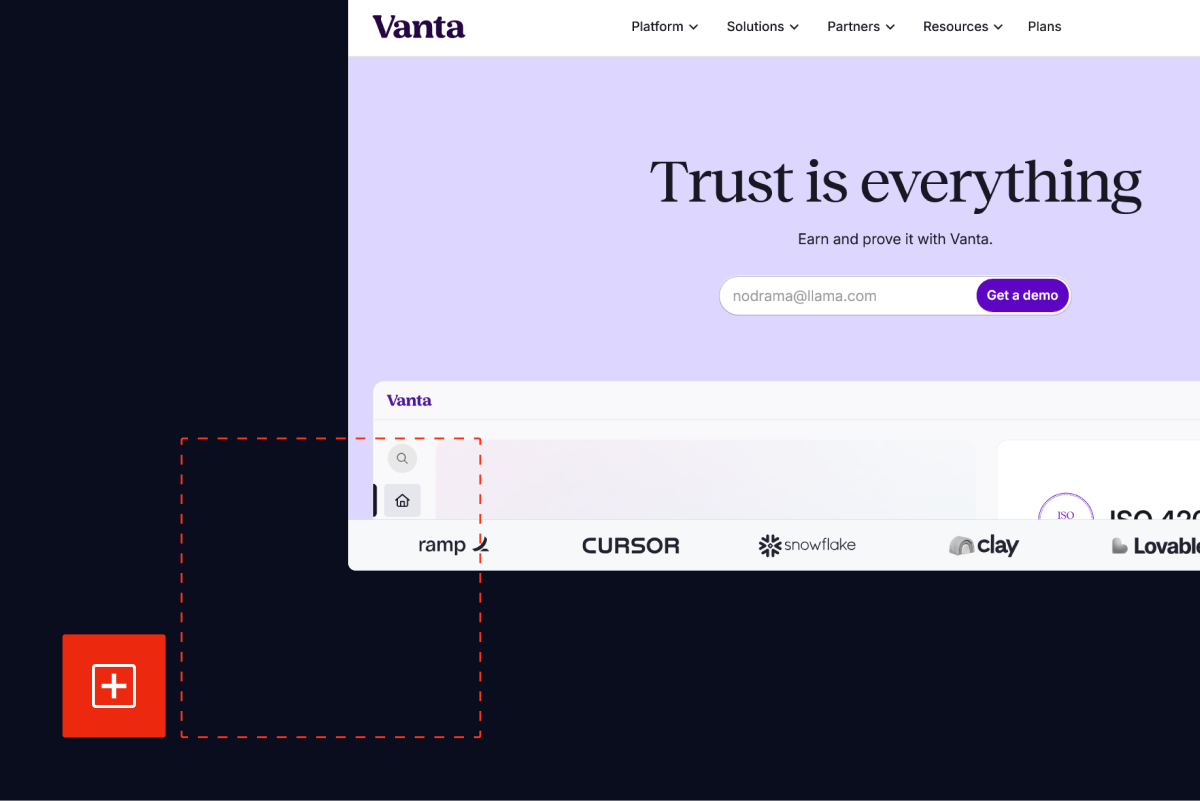
The site instantly identifies its audience, the outcome, and the frameworks that it supports. As opposed to opening with feature lists or technical implementation details, the messaging is focused on achieving and maintaining compliance across standards such as SOC 2, ISO 27001, HIPAA, and GDPR.
The trust architecture is equally disciplined. Customer logos are prominent, recognizable, and current. Security and compliance resources are simple to find, and the trust center is visible rather than hidden. Just as importantly, the site avoids many of the visual cliches common across cybersecurity marketing.
Framework Scores:
- Message Clarity: 5/5
- Trust & Proof Architecture: 5/5
- Audience Routing: 4/5
- Product Velocity Surface: 5/5
- Site Security Posture: 3/5
Another important lesson from Vanta isn’t the design system, but instead is the discipline of leading with frameworks and business outcomes instead of product features.
Buyers arrive asking, “Can this help me achieve SOC 2?” The site answers that question instantly.
Recommended: Drata - Industry-Specific and Framework-Specific Variants
Drata follows a lot of the same principles as Vanta but takes audience routing much further.
Instead of treating compliance as a single topic, Drata creates dedicated experiences for individual frameworks and industries. SOC 2, ISO 27001, HIPAA, FedRAMP, and PCI DSS each receive tailored content. Industries such as SaaS, fintech, and healthcare receive their own versions as well.
From a website architecture perspective, this is the correct pattern for a mature compliance platform. Different industries have different concerns, and different frameworks have different buying journeys. Drata reflects that reality instead of forcing everybody through a generic compliance page.
Framework Scores:
- Message Clarity: 5/5
- Trust & Proof Architecture: 5/5
- Audience Routing: 5/5
- Product Velocity Surface: 4/5
- Site Security Posture: 4/5
The pattern that’s worth copying is the framework-by-industry model.
The challenge here is maintaining it. Creating dozens of framework and industry pages is relatively easy. Keeping them accurate, differentiated, and useful requires strong content operations and governance.
Also Consider: Secureframe and Sprinto for Specific Patterns
Secureframe and Sprinto are both strong alternative options, but each of them emphasizes a different angle.
Secureframe increasingly positions AI-driven evidence collection and automation as a differentiator. The site does a good job connecting compliance work with operational efficiency, as opposed to treating audits as isolated projects.
Secureframe Scores:
- Message Clarity: 5/5
- Trust & Proof Architecture: 4/5
- Audience Routing: 4/5
- Product Velocity Surface: 5/5
- Site Security Posture: 4/5
Sprinto takes a different approach, focusing on affordability, simplicity, and ease of implementation for smaller teams that lack dedicated compliance resources.
Sprinto Scores:
- Message Clarity: 4/5
- Trust & Proof Architecture: 4/5
- Audience Routing: 4/5
- Product Velocity Surface: 4/5
- Site Security Posture: 5/5
The pattern that is common across all four vendors remains consistent. They lead with the framework first, and the product second. In compliance automation, buyers care about the destination before caring about the way in which the software works.
Cloud Security and Vulnerability Management Sites Worth Modeling
Cloud security and vulnerability management buyers rank among the most technical audiences across the cybersecurity landscape. They expect proof rather than promises. The best websites in the category understand this and use the product itself as evidence rather than relying on generic security marketing.
What Cloud Security Sites Have to Do
Cloud security platforms such as Wiz, Orca, Lacework, and Sysdig, alongside vulnerability management vendors like Tenable, Qualys, and Snyk sell to security architects, security engineers, platform teams, and CISOs responsible for protecting real infrastructure.
The buyer here is technical, skeptical, and typically familiar with competing products before they arrive on the site.
As a result, this category has different website requirements than compliance automation. Dashboard screenshots become critical proof assets. Product architecture matters, technical depth matters, and trust architecture matters more because the software has direct visibility into customer environments, cloud workloads, and production systems.
This is one of the most visually repetitive categories in cybersecurity.
Many vendors default to dark backgrounds, glowing gradients, abstract infrastructure graphics, and generic security messaging. The result here is a collection of websites that all look the same unless you know what the company is. And the strongest examples are able to avoid falling into this trap.
They show the product early, explain what it does, and use real screenshots. What’s more, they help technical buyers recognize how the platform fits into existing security programs.
Common failure modes are just as predictable, with marketing-heavy copy that frustrates technical evaluators, dashboard screenshots that reveal almost nothing about the product, and visual identities that can prove indistinguishable from the competition.
Recommended: Wiz - Visual Product Storytelling Done Right
Wiz is one of the defining cybersecurity websites of the past few years because it understands a simple principle - the product should be the hero.
Instead of leading with abstract messaging, Wiz instantly introduces visitors to the platform’s security graph and cloud visibility capabilities. Product visuals are the main story, not the support act.
Dashboard screenshots throughout the site feel credible because they show realistic environments, populated risk data, cloud assets, relationships, and findings. A visitor can understand what the platform does and how the security architect can use this on a daily basis.
The trust architecture is equally mature. Customer proof, analyst recognition, security resources, and technical documentation are all easy to discover. Product updates and company momentum remain visible, reinforcing the impression that the platform is actively evolving.
Framework Scores:
- Message Clarity: 5/5
- Trust & Proof Architecture: 5/5
- Audience Routing: 4/5
- Product Velocity Surface: 5/5
- Site Security Posture: 5/5
The lesson worth copying is straightforward: show the product.
Too many cybersecurity websites are reliant on illustrations, logos, or abstract value propositions. Wiz demonstrates that real product experiences are often the most persuasive marketing asset available.
Recommended: Snyk - Developer-First Site Design for a Developer-First Product
Snyk has a more complex audience challenge than many cybersecurity companies because of the fact it sells both developers and security teams. The site reflects this incredibly well.
Developer-focused content is highly visible. Documentation is easy to find, and product integrations are surfaced early. The free tier is prominent. GitHub and developer workflow references appear throughout the experience.
At the same time, the site provides enterprise-focused content for security leaders evaluating governance, compliance, vulnerability management, and organizational risk.
Having a dual-audience approach is challenging to execute. Many cybersecurity companies end up serving one audience well, while proving frustrating for the other. Snyk creates pathways for both.
The site also serves as an example for modern enterprise website architecture. BuiltWith verification confirms the platform, it also demonstrates that a complex cybersecurity website is able to maintain technical depth, extensive documentation, and enterprise-scale content operations.
Framework Scores:
- Message Clarity: 5/5
- Trust & Proof Architecture: 5/5
- Audience Routing: 5/5
- Product Velocity Surface: 5/5
- Site Security Posture: 5/5
Recommended: Fortinet FortiCNAPP (formerly Lacework) - Honest Specificity About What the Product Does
Fortinet’s FortiCNAPP, built on the technology acquired through its Lacework acquisition, operates in one of the most crowded segments of cybersecurity. Cloud security vendors routinely promise better visibility, faster detection, and strong risk reduction, making meaningful differentiation difficult.
What stands out about the FortiCNAPP site is its willingness to explain how the platform functions, instead of relying completely on outcome-based messaging.
Throughout the site, Fortinet spends time explaining how FortiCNAPP connects cloud security posture management (CSPM), cloud infrastructure entitlement management (CIEM), cloud detection and response (CDR), application security, and compliance monitoring into a unified platform. The product’s behavioral analytics capabilities and machine-learning-driven threat detection are also explained with a level of specificity that technical buyers expect.
Whether a visitor ultimately agrees with the positioning matters less than making sure that methodology is articulated effectively. Security architects tend to respond better to explanations of how platforms identify risks, as opposed to broader claims about superior protection.
Framework Scores:
- Message Clarity: 4/5
- Trust & Proof Architecture: 5/5
- Audience Routing: 4/5
- Product Velocity: 4/5
- Site Security Posture: 4/5
The lesson here is that specificity creates credibility. In technical categories, explaining the way products work, which data is analyzed, and how to prioritize threats can be often more persuasive than making the claim for better outcomes than the competition.
Identity and Access Sites Worth Modeling
Identity and access management covers a broad range of buyers in cybersecurity, including enterprise identity platforms, password managers, and developer-first access tools. This makes audience routing among the most essential design challenges on the website.
What Identity and Access Sites Have to Do
Identity and access vendors serve dramatically different audiences despite often solving related problems.
Enterprise identity providers such as Okta and Auth0 sell into CIO-led buying processes involving security teams, IT operations, compliance stakeholders, and procurement. Password managers like 1Password and Bitwarden often start with individual users or small teams before they expand into larger organizations. Modern access platforms such as Tailscale and Twingate frequently start with developers and infrastructure teams.
The result is a category with a wide range of buyer sophistication, technical depth, and budget expectations.
This creates a website challenge that a lot of cybersecurity categories don’t face. A single homepage will often need to cater to multiple audiences without making any of them feel lost. Enterprise buyers need trust signals and compliance documentation. Developers require technical clarity, and team leaders need pricing and implementation details.
The strongest websites solve this through disciplined audience routing. They create clear paths based on role, use case, and organizational maturity.
Recommended: Okta - Enterprise Identity Done at Enterprise Scale
Okta operates one of the most mature enterprise marketing ecosystems in cybersecurity.
The challenge facing the company is significant. Workforce identity, customer identity, developer authentication, and access management all live under a single corporate umbrella. Auth0 adds another layer of complexity, serving developers and product teams with different priorities than more traditional enterprise buyers.
Despite this complexity, the site generally avoids becoming confusing.
Audience routing is the standout strength. Enterprise IT leaders, security teams, developers, and customer identity buyers all have clear pathways into relevant content. Navigation structure reflects the way in which different audiences evaluate identity solutions, instead of forcing them into a single journey.
The trust architecture here is equally strong. Compliance documentation, certification, analyst recognition, security resources, and framework coverage are extensive. Customer proof is enterprise-scale, which reinforces Okta’s role as market leader.
Framework Scores:
- Message Clarity: 4/5
- Trust & Proof Architecture: 5/5
- Audience Routing: 5/5
- Product Velocity Surface: 4/5
- Site Security Posture: 3/5
The audience-routing model is the core lesson worth copying. Companies that serve multiple identity use cases need to study how Okta separates workforce, customer, and developer journeys without fragmenting the brand experiences.
Recommended: 1Password - Consumer-Polish Design for a B2B Product
1Password stands out because of the fact it feels completely different versus many cybersecurity websites.
While many vendors are reliant on enterprise design conventions, 1Password adopts a warmer and more approachable visual language. This site is closer to a consumer software experience than traditional cybersecurity platforms, and this is exactly the right choice for a product used by individuals, families, and enterprise organizations.
Messaging here is clear and obvious: visitors understand what the product does, who it serves, and why it’s crucial within moments of landing on the site.
The trust architecture is also powerful. Security audits, encryption practices, Watchtower monitoring capabilities, and security resources are straightforward to find without overwhelming people. The site is consistently able to balance accessibility with credibility.
Framework Scores:
- Message Clarity: 5/5
- Trust & Proof Architecture: 5/5
- Audience Routing: 5/5
- Product Velocity Surface: 5/5
- Site Security Posture: 5/5
The lesson to learn here is that cybersecurity websites don’t need to look intimidating. In fact, consumer-grade usability is a strong competitive advantage when the product is genuinely designed for both technical and non-technical users.
Recommended: Tailscale - Developer-First Access Done Honestly
Tailscale is successful due to the fact that it keeps what is ultimately a straightforward value proposition blessedly simple and straightforward.
The site explains modern networking and secure access in plain and simple language. Product explanations are direct, CLI workflows, documentation is simple to access, and pricing is transparent.
This is a level of clarity that is pretty rare in the cybersecurity space.
The company is also unexpectedly transparent when it comes to technical approach, open-source components, and security model. Technical buyers are given enough detail to help them evaluate the product without having to force visitors into deep documentation.
Framework Scores:
- Message Clarity: 5/5
- Trust & Proof Architecture: 5/5
- Audience Routing: 4/5
- Product Velocity Surface: 5/5
- Site Security Posture: 4/5
Make sure to explain what the product is, how it works, and what it costs. Directness is often more persuasive for technical buyers than trying to use sophisticated marketing language.
Two Things Every Cybersec Roundup Misses: Trust Centers and Your Own Security Headers
Most cybersecurity website roundups stop at homepage design. A more important and in-depth evaluation typically begins once the homepage has been done, when buyers begin looking for evidence, compliance documentation, and signs that the vendor takes security practices seriously.
Trust Center Architecture: What it is and What Belongs There
This is the section too often ignored by every cybersecurity website roundup.
A trust center is a dedicated section of the website, generally hosted at a URL trust like /trust, /security, or a specific subdomain that consolidates the information security, procurement, legal, and compliance teams need during the vendor evaluation process.
Enterprise security buyers often find the trust center more important than the homepage. The homepage creates interest, while the trust center helps with closing the deal.
When procurement teams start requesting documentation, security questionnaires, compliance certifications, and evidence packages, the trust center’s quality often determines how quickly an evaluation moves.
The strongest trust centers share a consistent structure.
They provide a clear and filterable list of certifications and attestations that include SOC 2, ISO 27001, HIPAA, PCI DSS, FedRAMP, and any framework relevant to the product category. Documentation should be simple to locate, and clearly labeled. Some organizations select open access, while others need NDA or customer verification before downloads. Either approach can work if expectations are clear.
A strong trust center need to include:
- A current subprocessor list with effective dates
- Security FAQs written in plain language
- A documented incident response process
- A vulnerability disclosure policy
- Contact information for security and compliance questions
- Compliance and certification status updates
Vanta’s trust center and Drata’s trust center are among the strongest examples in the category because both recognize that procurement teams are trying to answer specific questions quickly as opposed to browsing marketing content.
There’s also a discoverability component here that a lot of vendors overlook. Many trust centers contain some of the most valuable information on the entire site, but many remain difficult to find via navigation and search. Proper information architecture, crawlability, and technical SEO services are essential here as much as they are on commercial pages.
Site Security Posture: The Cybersec Vendor’s Own Headers Matter
The second blind spot across most cybersecurity website roundups is the vendor’s own website security posture.
A cybersecurity company shipping a marketing site with missing Content Security Policy, no HSTS, no X-Frame-Options, and no Referrer-Policy is sending a signal to security-conscious buyers whether it means to or not.
A lot of security practitioners routinely run vendor websites through SecurityHeaders.com or Mozilla Observatory during the evaluation process. The marketing site isn’t the product, but buyers can find it difficult to separate the two.
If your website gets a weak grade, this can color the perception of the company. So the goal here is competence rather than perfection.
Each cybersecurity vendor needs to aim for a minimum A grade on SecurityHeaders.com and implement the fundamentals in a consistent way:
- Content Security Policy (CSP), even if deployed in report-only mode initially
- HSTS with includeSubDomains and preload enabled
- X-Frame-Options set to DENY or SAMEORIGIN
- Referrer-Policy configured appropriately
- X-Content-Type-Options enabled
- Third-party scripts and trackers reviewed regularly
One interesting finding from the examples in this article is that category leadership doesn't automatically translate into stronger security-header implementation. Many well-known cybersecurity vendors scored below smaller competitors when evaluated against website security controls.
For teams building on Webflow, this is a discussion that often raises questions with regards to platform limitations. While Webflow doesn’t natively expose all security-header configuration options, teams can implement advanced header controls via reverse proxies, CDN configuration, and supporting infrastructure layers. Many of these implementation decisions also impact Webflow SEO, crawlability, and overall site performance.
Where Webflow Sits in This Conversation
This is where many cybersecurity teams become unnecessarily cautious about Webflow.
Webflow can absolutely host a serious cybersecurity marketing website. It can support trust centers, documentation hubs, resource libraries, case studies, product marketing pages, and enterprise buying journeys.
What it should not host is the security-sensitive application layer itself. This is a distinction that matters.
The marketing site, trust center, and educational content can live on Webflow. Customer application, authenticated user environment, customer portals, and infrastructures responsible for processing sensitive customer data needs to remain on dedicated product infrastructure.
This isn’t a compromise, but, rather, understanding the way modern cybersecurity companies structure their web stack.
Websites and trust centers serve as the public-facing trust layer. Applications operate independently on infrastructure designed specifically for product security, compliance, and operational requirements.
For cybersecurity companies considering modernization projects, this separation makes migration considerably easier because marketing teams become more flexible without introducing risk into the product environment.
Shipping a marketing site with a real trust center and proper security headers on Webflow is its own skillset. See how we build.
Cybersec Site Migration, Anti-Patterns to Avoid, and How to Start
The strongest cybersecurity websites are not often the result of a homepage redesign alone. They’re usually the outcome of better platform decisions, clearer positioning, and a website architecture designed to support marketing velocity over the long term.
The Migration Reality for Cybersec Marketing Teams
Cybersecurity marketing teams operate at a pace that many legacy websites are unable to support.
New product launches, compliance frameworks, category repositioning, analyst reports, trust-center updates, and threat research all create constant publishing demands. When changes require developer tickets, marketing becomes more dependent on engineering capacity rather than customer needs. This is the area where the migration case is a compelling one.
Many cybersecurity vendors continue to operate on WordPress, Drupal, or internal CMS platforms that might have accumulated years of technical debt. This results in slower publishing workflows, inconsistent governance, and greater operational overhead. For a deeper look at the migration considerations involved, see Webflow versus Sitecore.
The strongest migration candidates are typically companies whose development teams don’t want to maintain the marketing stack, but whose teams need greater control of content operations.
Shadow Digital works with organizations facing this exact challenge, helping them modernize website operations without disrupting product infrastructure. If Shadow has a relevant cybersecurity example available, link to our cybersec migration case study here.
Three Anti-Patterns Still Common in Cybersec Sites in 2026
The first anti-pattern is the 3D hacker aesthetic.
Cyan-on-black color palettes, glitched typography, and floating particles are all overused characteristics that nowadays signal a misunderstanding of the buyer. Security professionals don’t need to be reminded visually that hackers exist.
So be sure to prioritize clarity of theatricality. Vanta and 1Password showcase that credibility comes as a result of confidence, as opposed to visual intimidation.
The second anti-pattern is fear-driven copy.
Too many cybersecurity sites continue to lead with attack statistics, breach stories, or apocalyptic warnings. However, buyers already understand the risks, they’re here for a solution.
A more effective approach is to lead with the outcome by explaining what the product does, who helps it, and why it is important.
The third anti-pattern is undifferentiated dark mode.
Dark-themed cybersecurity websites have become so common that they typically blend together. If every competitor makes the same visual choice, the choice is no longer distinctive.
The strongest examples of this create differentiation elsewhere. Snyk’s purple-led visual identity, Wiz’s product-first storytelling, and 1Password’s approachable design language all stand out due to their ability to avoid category cliches.
A Practical Starting Plan
The majority of cybersecurity companies don’t need to rebuild everything immediately.
Instead, start by identifying your category and scoring your website against the five-point framework used throughout this article.
Next, make sure you audit your center and website security posture. Many organizations discover that their biggest issues aren’t visual design problems, but missing documentation, poor audience routing, or weak trust architecture.
Then make sure you choose the most relevant example from this article as a benchmark. Compliance automation vendors shouldn’t copy a developer-first platform, and vice versa.
Lastly, determine whether the right path is an incremental improvement program or a full migration. The determining factor is typically marketing velocity. If your CMS slows publishing, governance, experimentation, and content operations, the platform might be the issue as opposed to the website itself.
Cybersecurity websites mostly fail at the same things, which is also good news: they are all fixable.
Pick a category position. Score your site against the five points. Build a real trust center. Configure your security headers like you actually care about web security. Migrate off the legacy CMS if it is the bottleneck. None of this is mysterious. We do it across cybersec vendors at growth stage and mid-market. If you want help, or you want a second opinion on your current site, we should talk.