Best Headless Commerce Platforms in 2026: Ranked by Fit, Architecture & Cost

Let's Build Your Webflow Website!
Partner with experts who understand your vision. Let’s create a converting user experience and build your website for future growth.
Headless commerce has been a marketing term for long enough that it's worth separating what it actually means from what vendors claim it means.
In practice, headless commerce means decoupling the front-end presentation layer from the back-end commerce logic. Instead of a monolithic platform where the storefront, catalog, cart, and checkout are tightly coupled, the commerce back-end exposes everything via API, and the front-end is built separately - in Next.js, Nuxt, Astro, or any other framework - consuming those APIs.
What it enables: complete control over the user experience, the ability to deliver commerce experiences across any channel (web, mobile, in-store kiosks, voice), and the freedom to choose best-of-breed front-end tooling without being constrained by a platform's template system.
What it costs: engineering time, operational complexity, and the absence of the opinionated defaults that make traditional platforms fast to deploy.
This guide covers the realistic headless commerce platforms available in 2026 - open-source and SaaS, enterprise and mid-market - with honest assessments of team requirements, total cost of ownership, and when each is the right choice.
What "Headless" Actually Means in 2026
The term is applied loosely. These are the meaningful distinctions:
Headless SaaS (Shopify Hydrogen, BigCommerce Catalyst): A managed commerce back-end with a headless front-end option. The back-end is fully managed; you build the front-end. You get SaaS reliability and managed infrastructure with front-end freedom, but you don't own the back-end components.
API-first composable (commercetools, Elastic Path): Every commerce service - pricing, catalog, cart, promotions, checkout - is an independent API-accessible service. You can replace individual components, integrate best-of-breed services, and own the entire stack. This is "true" composable commerce. The cost is proportionate to the control.
Open-source headless (Medusa, Saleor, Vendure): Self-hosted commerce engines with clean APIs and no licensing cost. You own the code and the infrastructure. The engineering requirement is similar to composable platforms, but licensing cost is zero.
Commerce Layer approach (Commerce Layer): A pure-play commerce API layer designed to sit underneath an existing CMS or front-end, handling the commerce logic (pricing, cart, checkout, orders) without replacing the content management layer. Particularly well-suited to content-rich commerce where the CMS is the primary front-end driver.
Evaluation Criteria
Platforms in this guide are assessed on:
- API quality: Completeness, documentation, rate limits, and consistency of the API surface
- B2B capability: Company accounts, price lists, approval workflows
- Multi-storefront: Running multiple storefronts from one back-end
- Team skill requirement: What engineering capability is required to implement and operate
- Front-end pairing: Which front-end frameworks and patterns are supported or recommended
- Operational complexity: Infrastructure, upgrades, monitoring, and ongoing maintenance
- Total cost of ownership: Licensing plus implementation plus ongoing operations
Platform Comparison
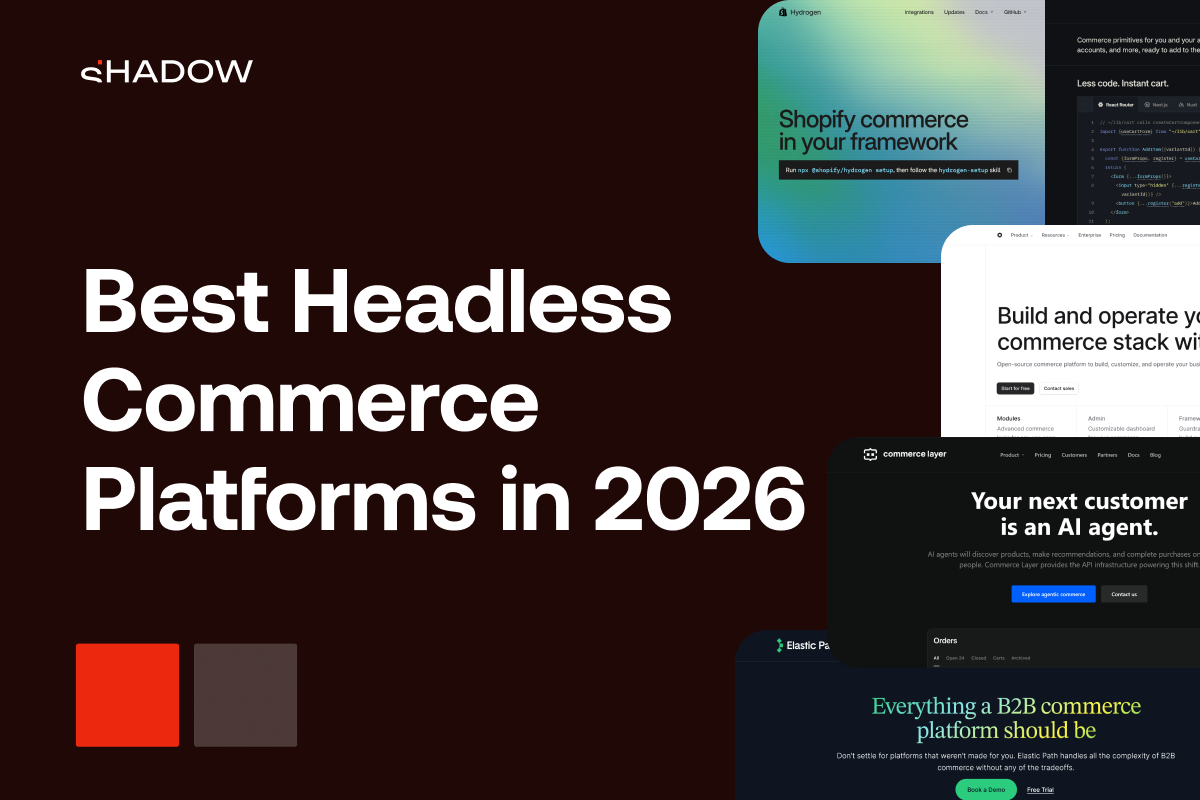
Shopify Hydrogen (Shopify Plus)
Shopify Hydrogen is Shopify's official headless commerce framework - a React-based front-end framework built on Remix, designed to consume Shopify's Storefront API (GraphQL) and build fully custom storefronts while keeping the Shopify Plus back-end as the commerce engine.
The key characteristic of Shopify Hydrogen: it's headless in terms of front-end freedom, but the back-end is still Shopify's managed SaaS. You build in React/Remix, deploy on Shopify's Oxygen hosting, and consume the Storefront API. Shopify handles the catalog, cart, checkout, orders, and fulfillment.
Who it's right for: Teams that want custom storefront design and development freedom without leaving Shopify's managed infrastructure. Front-end developers comfortable with React and Remix. Brands that want headless UX without the operational overhead of a self-hosted commerce back-end.
Who it isn't right for: Teams that need to customise or replace back-end commerce logic. Organisations making a deliberate architectural move to component-level ownership. The ceiling is Shopify's APIs - if you need to modify the checkout back-end, the pricing engine, or the order management logic, Hydrogen doesn't remove that constraint.
Team requirement: React/Remix front-end developers. Shopify Plus subscription. No separate back-end infrastructure.
Pricing: Shopify Plus subscription from $2,300/month. Oxygen hosting is included. Front-end development is the primary additional cost.
Strengths
- Shopify's managed reliability and SLA
- Full Shopify ecosystem (apps, integrations, payment methods)
- React/Remix framework familiar to modern front-end teams
- Shopify Checkout reliability and Checkout Extensibility for customisation
- Oxygen hosting included at no extra cost
- Largest commerce developer community
Weaknesses
- Back-end is still Shopify; composable architecture goals are front-end only
- Checkout logic ceiling: Shopify Functions, not open back-end code
- Shopify Plus subscription required
- Less appropriate for complex B2B than dedicated B2B platforms
BigCommerce Catalyst
BigCommerce Catalyst is BigCommerce's official headless starter - a Next.js-based reference architecture using BigCommerce's GraphQL Storefront API. Like Hydrogen for Shopify, it provides a structured approach to headless front-end development on the BigCommerce back-end.
Catalyst is newer than Hydrogen and the community is smaller, but it's actively developed and provides a solid starting point for teams wanting headless delivery on BigCommerce.
Who it's right for: Teams building headless storefronts on BigCommerce Enterprise, particularly those with Next.js expertise.
Team requirement: Next.js / React front-end developers. BigCommerce Enterprise subscription.
Pricing: BigCommerce Enterprise subscription (quote-based). Front-end development cost.
Commercetools
Commercetools is the enterprise benchmark for composable commerce. Every service - product catalog, pricing, cart, promotions, checkout, order management - is delivered as an independent API. Nothing is bundled. The front-end is entirely yours to build; the back-end is entirely yours to compose.
This is MACH architecture (Microservices, API-first, Cloud-native, Headless) at its most complete. Commercetools is used by major retailers and brands who have made a deliberate decision to own their commerce architecture at the component level - the ability to replace the pricing engine, run a custom checkout service, and orchestrate best-of-breed services without being locked into any single vendor's stack.
The honest commercetools picture: most organisations don't need this level of architectural control, and those that don't will pay the full implementation and engineering cost without extracting proportionate value. Commercetools is right when the organisation has identified a specific, non-trivial reason why a managed SaaS back-end cannot serve their requirements.
Who it's right for: Large enterprise merchants ($100M+ GMV) with dedicated platform engineering teams making a deliberate architectural ownership decision. Organisations with custom pricing, inventory, or checkout logic that cannot be expressed through SaaS extension points.
Who it isn't right for: Mid-market merchants or engineering teams without composable architecture expertise. Organisations where the driver is cost reduction - commercetools almost always increases total cost compared to managed SaaS.
Team requirement: Platform engineering team (3-8+ engineers for initial build); ongoing engineering capacity for maintenance and evolution.
Pricing: Usage-based (API calls and data volume). Enterprise contracts from 50,000-150,000+/year in licensing. Implementation: 300,000-1,000,000+.
For more on commercetools and when alternatives are appropriate, see Commercetools Alternatives 2026.
Strengths
- Maximum architectural flexibility: every component is replaceable
- MACH-compliant: future-proof for composable architecture evolution
- Enterprise-grade reliability and SLA
- Multi-region, multi-currency, multi-storefront native
- Deepest API surface of any platform in this guide
Weaknesses
- Highest total cost of any platform in this guide
- Requires dedicated platform engineering team
- Long implementation timelines (12-24+ months for full build)
- No out-of-the-box storefront; front-end is entirely from scratch
Elastic Path
Elastic Path is the composable commerce platform positioned to deliver Commercetools-comparable architecture with faster time to value. Its Product Experience Manager (PXM) handles complex catalog requirements - multiple price books, complex product structures, multi-location inventory - through configuration rather than custom code, reducing the engineering overhead that makes commercetools slow to deploy.
Elastic Path also offers Composable Starter: pre-built reference architectures and integration patterns that accelerate the front-end build compared to starting from scratch. For organisations committed to composable architecture but constrained by engineering capacity or timeline, Elastic Path is the more pragmatic choice.
Who it's right for: Organisations in the commercetools evaluation tier who want composable architecture with faster time to market. Mid-to-large enterprise merchants with complex catalog or multi-channel requirements.
Team requirement: Engineering team, though smaller than commercetools requires. API-first development experience.
Pricing: Enterprise, quote-based. Typically 50,000-200,000+/year in licensing. Implementation is substantial but typically less than commercetools.
Strengths
- API-first, MACH-compliant - comparable philosophy to commercetools
- PXM for complex catalog without heavy custom development
- Composable Starter reduces initial build time
- Strong for multi-channel and multi-region
- More accessible implementation than commercetools
Weaknesses
- Smaller community and ecosystem than commercetools
- Still requires engineering investment; not SaaS-simple
- Enterprise pricing not appropriate for smaller organisations
Medusa
Medusa is an open-source Node.js commerce platform built for engineering-led teams who want API-first commerce without licensing cost. Its modular architecture covers product catalog, cart, checkout, promotions, and order management through individual modules that can be extended or replaced.
Medusa's architectural alignment with composable commerce - combined with zero licensing cost and a JavaScript/TypeScript codebase that fits modern front-end teams - makes it the most practically accessible open-source headless commerce option in 2026. The community has grown significantly, the documentation is good, and enterprise adoption is increasing.
Who it's right for: Engineering-led teams who want headless commerce architecture with full code ownership and no licensing cost. Startups and scale-ups with JavaScript/TypeScript development capability. Teams leaving Shopify Plus or BigCommerce for architectural reasons who can't justify commercetools' licensing and implementation cost.
Team requirement: Node.js/TypeScript developers. Infrastructure capacity for self-hosted deployment (or Medusa Cloud for managed option).
Pricing: Open-source (self-hosted): free. Medusa Cloud: pricing announced but verify current terms at medusajs.com.
Strengths
- Free open-source; no licensing cost
- Node.js/TypeScript codebase familiar to modern front-end teams
- Modular architecture: extend or replace individual commerce components
- Active community with growing enterprise adoption
- Full code ownership; no vendor lock-in
- Good documentation and front-end framework integrations
- Growing integration ecosystem
Weaknesses
- Less mature than commercetools for large enterprise requirements
- Self-hosted requires infrastructure management
- Smaller partner ecosystem than enterprise platforms
- High-availability and enterprise reliability requires engineering effort
Saleor
Saleor is an open-source, GraphQL-native commerce platform. Where Medusa uses REST with GraphQL support, Saleor was built GraphQL-first - the API design is clean, type-safe, and well-documented, which makes it a strong choice for engineering teams that have adopted GraphQL as their standard.
Saleor offers both self-hosted open-source and a managed Saleor Cloud deployment, reducing infrastructure management overhead while retaining the open-source licensing model.
Who it's right for: Engineering teams that prefer GraphQL-native APIs. Teams building content-first commerce where the headless architecture is paired with a GraphQL CMS (Contentful, Hygraph). Python/Django teams with existing ecosystem knowledge.
Team requirement: GraphQL/Python development capability. Infrastructure for self-hosted or Saleor Cloud subscription.
Pricing: Open-source: free. Saleor Cloud: pricing starts at a free tier with paid plans for production use - verify current pricing at saleor.io.
Strengths
- GraphQL-native: clean, type-safe, well-documented API
- Open-source with managed cloud option
- Included dashboard and admin UI
- Good front-end framework integrations
- Active community
Weaknesses
- Python/Django back-end is less familiar to Node.js-centric front-end teams
- Smaller enterprise reference base than commercetools or Medusa
- Less B2B feature depth for complex wholesale requirements
Vendure
Vendure is an open-source, TypeScript-based headless commerce framework with a plugin-first architecture. It's built on Node.js with GraphQL API and is designed for teams that want a strongly typed, extensible commerce engine without licensing cost.
Vendure differentiates on its plugin system: core commerce behaviour can be extended through a structured plugin architecture rather than forking the codebase, which makes it easier to upgrade while maintaining customisations.
Who it's right for: TypeScript-first engineering teams who want a structured extension model. Teams building complex, heavily customised commerce experiences where a clean plugin architecture matters for maintainability.
Team requirement: TypeScript/Node.js developers. Infrastructure for self-hosted deployment.
Pricing: Open-source: free. Self-hosted.
Strengths
- Full TypeScript: strong typing end-to-end
- GraphQL API
- Plugin-first architecture for structured extensibility
- Good documentation
- Active community
Weaknesses
- Smaller community and ecosystem than Medusa or Saleor
- Self-hosted only (no managed cloud option as of 2026 - verify current status)
- Less enterprise adoption than other open-source options
Commerce Layer
Commerce Layer is a unique position in this guide: it's not a full commerce engine but a commerce API layer designed to sit underneath an existing CMS or front-end, handling the transactional layer (prices, cart, checkout, orders) while the content and experience layer is managed separately.
This architecture is particularly well-suited to content-rich commerce - brands where the content experience is primary and the commerce functionality is integrated into it, rather than the other way around. A luxury brand's editorial website that needs to sell products without compromising its content-first design is the canonical Commerce Layer use case.
Who it's right for: Content-first brands, media companies with commerce, editorial-driven luxury or lifestyle brands. Teams whose primary CMS is Contentful, Prismic, Dato, or a similar headless CMS and who want commerce functionality added cleanly.
Team requirement: Front-end developers comfortable with JavaScript/TypeScript. CMS and commerce API integration experience.
Pricing: From $500/month for mid-market plans. Enterprise pricing is quote-based.
Strengths
- Designed for content-first commerce - doesn't fight the CMS for primacy
- Clean API for prices, cart, checkout, and orders
- Strong integration with headless CMS platforms
- Multi-currency and multi-market native
Weaknesses
- Not a full commerce engine; catalog management is minimal
- Less appropriate for catalog-heavy ecommerce
- Smaller community than full-platform alternatives
Pricing and TCO Reality
The honest headless commerce TCO picture has three components most analyses underweight: front-end build cost, platform team cost, and ongoing engineering cost.
All figures are planning estimates only. Actual costs are highly variable by scope, agency rates, team size, and implementation complexity.
The key insight from this table: open-source platforms (Medusa, Saleor, Vendure) are not "free" - the engineering cost to build and maintain a production headless commerce implementation is comparable to Shopify Hydrogen's Year 1 TCO. The licensing saving is real, but the engineering cost is not eliminated.
Decision Framework by Company Stage
Early Stage / Small Team (Under $5M GMV, Team of 1-5 Engineers)
Recommendation: Shopify Hydrogen or standard Shopify Plus with custom storefront.
Building a full headless commerce implementation requires engineering capacity that most small teams don't have available without crowding out product and growth work. Shopify's managed back-end removes infrastructure risk and maintenance overhead. Hydrogen provides front-end freedom within that constraint. The opportunity cost of custom-building a commerce engine at this stage is significant.
Growth Stage ($5-50M GMV, Engineering Team of 5-20)
Recommendation: Shopify Hydrogen, BigCommerce Catalyst, or Medusa depending on specific requirements.
At this stage, a headless architecture is viable if the front-end experience differentiation is a real competitive requirement - not a nice-to-have. If the driver is design freedom, Hydrogen or Catalyst on a managed back-end is the lower-risk path. If the driver is back-end control or licensing cost, Medusa is the strongest open-source option.
The question to ask honestly: is the headless architecture solving a real problem for the business at this stage, or is it a technical goal that the product strategy doesn't yet require?
Enterprise ($50M+ GMV, Dedicated Platform Team)
Recommendation: Commercetools, Elastic Path, or a managed headless SaaS (Shopify Hydrogen) depending on the architectural goal.
For organisations making a deliberate architectural ownership decision, commercetools is the standard choice. For organisations that want composable architecture with faster time to value, Elastic Path. For organisations whose goal is front-end freedom with managed back-end reliability at scale, Shopify Hydrogen with Shopify Plus Enterprise terms.
Content-First Commerce (Any Stage)
Recommendation: Commerce Layer, paired with the existing headless CMS.
For editorial-driven brands where the CMS is primary and commerce is secondary, Commerce Layer's architecture is specifically designed for this use case. It doesn't compete with the CMS; it completes it.
Front-End Pairing Notes
Webflow as the Front-End Layer
Webflow is not a natural pairing with headless commerce back-ends - Webflow's visual editor and CMS are designed for content and marketing pages, not for dynamic commerce experiences (product listing pages, cart, checkout). Webflow can be used for the marketing and content pages of a headless commerce site, with a separate commerce-native front-end (Next.js, Nuxt, Astro) handling the commerce experience, connected to the same headless back-end.
This architecture - Webflow for content pages, Next.js for commerce - is used by brands that want Webflow's design system and CMS for their editorial content while maintaining a custom commerce experience. It requires careful routing and consistent design system implementation across the two layers.
Next.js
Next.js is the most common front-end framework for headless commerce in 2026. It's the foundation of BigCommerce Catalyst, one of the common Shopify Hydrogen deployment options, and the preferred pairing for commercetools, Elastic Path, and Medusa. The combination of server-side rendering, edge deployment, and the React component ecosystem makes it well-suited to commerce performance requirements.
Nuxt / Vue
Nuxt is the Vue equivalent of Next.js and a strong choice for teams with Vue expertise. It's supported by most headless commerce platforms, though the reference architectures and community resources are more limited than Next.js.
Astro
Astro is gaining adoption for content-first commerce sites where most pages are largely static and the commerce interaction is limited (cart, checkout). Its content-first architecture and partial hydration model produce excellent performance for catalog pages and editorial content.
Work with Shadow Digital
Headless commerce architecture is a decision that shapes every subsequent build, integration, and design system choice. Getting the platform right before the front-end is built matters more than getting the front-end right before the platform is settled.
Shadow Digital builds on Webflow and Next.js for commerce clients, and advises on headless platform selection and architecture before builds begin. If the platform question is unresolved, the build question is premature.
Book a strategy call to work through your platform architecture. Or see our work to see headless commerce builds in practice.
A Note on Sources
Platform pricing in this article is drawn from publicly available pricing pages and documentation at time of writing. Commercetools, Elastic Path, and Commerce Layer pricing is quote-based and variable - all figures are estimates for planning purposes only. Open-source platforms (Medusa, Saleor, Vendure) are free to self-host; Medusa Cloud and Saleor Cloud pricing is published on respective vendor sites - verify current terms before budgeting. TCO figures are illustrative estimates; actual costs depend heavily on scope, team rates, and implementation complexity. MACH Alliance certification and platform architectural claims should be verified directly with vendors, as positioning evolves.
Frequently Asked Questions
What Is Headless Commerce and Do I Need It?
Headless commerce decouples the commerce back-end (catalog, cart, checkout, orders) from the front-end presentation layer, connecting them via API. It enables complete front-end design freedom, omnichannel delivery, and best-of-breed technology choices. Whether you need it depends on whether your current platform's front-end constraints are a real business problem. If your storefront requirements can be met within a traditional platform's template system, headless architecture adds engineering cost and complexity without proportionate benefit. If you need front-end freedom for a genuinely differentiated experience across multiple channels, headless architecture is the right foundation.
What Is the Difference between Headless and Composable Commerce?
Headless commerce typically refers to decoupling the front-end from a monolithic back-end - the back-end remains a managed whole, accessible via API. Composable commerce goes further: every back-end service (pricing, catalog, promotions, checkout) is also an independent, replaceable API component. All composable commerce platforms are headless, but not all headless platforms are composable. Shopify Hydrogen is headless but not composable (the back-end is Shopify's SaaS). Commercetools is both headless and composable.
Is Medusa Production-Ready in 2026?
Yes, for the right use cases. Medusa is being used in production by a growing number of merchants and is actively maintained with regular releases. It is less mature than commercetools for large enterprise requirements - complex multi-region deployments, very high traffic, or sophisticated B2B - but it's well-suited to mid-market and growth-stage builds. Assess it against your specific requirements rather than against an enterprise-scale benchmark.
How Long Does a Headless Commerce Implementation Take?
A headless commerce build - from platform selection to launch - typically takes 4-9 months for a Shopify Hydrogen or BigCommerce Catalyst implementation at mid-market scope. Commercetools implementations at enterprise scope typically take 12-24 months. Open-source platforms (Medusa, Saleor) are closer to the Hydrogen/Catalyst range if the team has headless commerce experience.
Is Shopify Headless?
Shopify Plus supports headless storefronts via its GraphQL Storefront API. Hydrogen is Shopify's official headless framework for building custom storefronts. Shopify's back-end remains a managed SaaS - it's not composable in the sense that you can replace the checkout or pricing engine - but the front-end is fully decoupled and customisable.
Which Headless Commerce Platform Is Best for B2B?
For enterprise B2B with complex requirements, commercetools (via API) or Adobe Commerce (which has a comprehensive B2B module). For mid-market B2B with standard requirements (company accounts, price lists, purchase orders), Shopify Plus Hydrogen delivers the same back-end B2B capabilities as standard Shopify Plus. Medusa and Saleor have basic B2B capabilities that can be extended through custom development. For the deepest out-of-the-box B2B in a headless architecture, see Commercetools Alternatives 2026 for the full B2B comparison.