Best Commercetools Alternatives in 2026 (Compared)

Let's Build Your Webflow Website!
Partner with experts who understand your vision. Let’s create a converting user experience and build your website for future growth.
Commercetools is the benchmark for composable commerce. It's API-first, MACH-certified, deeply flexible, and used by some of the world's largest retailers. It's also expensive to implement, requires a strong engineering team to operate, and takes significantly longer to get to market than most alternatives.
That gap - between what commercetools offers architecturally and what most organisations can realistically use - is why the alternatives conversation exists. Teams evaluating commercetools often discover that they want composable architecture in principle but don't have the engineering capacity or timeline to deliver it in practice.
This guide covers the realistic alternatives: what they offer, who they fit, and how to choose between composable-but-faster options, SaaS platforms that handle most requirements out of the box, and open-source paths for engineering-led teams.
Quick Comparison
All pricing figures are indicative. Enterprise platforms are quote-based - verify with each vendor.
Top Alternatives in Detail
Elastic Path
Elastic Path is the most direct architectural alternative to commercetools. It's API-first, headless, and composable - built for the same class of organisations that commercetools targets - but with a deliberate focus on reducing the engineering overhead required to launch.
The key product differentiator is the Product Experience Manager (PXM): a flexible catalog management system that handles complex product structures, multiple price books, and multi-location inventory without requiring custom development for each configuration. Where commercetools often needs engineering work to model unusual catalog requirements, Elastic Path's PXM is designed to handle them through configuration.
Elastic Path also offers Composable Starter, a set of pre-built reference architectures and integrations that reduce the front-end build time compared to starting from scratch on commercetools. For organisations committed to composable architecture but constrained by engineering capacity or timeline, Elastic Path is the most relevant alternative.
Strengths
- API-first, MACH-compliant - comparable architectural philosophy to commercetools
- PXM handles complex catalog requirements without heavy custom development
- Faster time to value than commercetools via Composable Starter and pre-built integrations
- Strong for multi-channel and multi-region retail
Weaknesses
- Still requires engineering investment; not a plug-and-play SaaS
- Smaller community and partner ecosystem than commercetools
- Enterprise pricing; not appropriate for smaller organisations
BigCommerce Enterprise
BigCommerce is an open SaaS platform - meaning it provides a hosted, managed ecommerce back-end with open APIs for headless front-end builds, without the implementation overhead of a pure API-first platform.
For organisations that want headless commerce capability without building the entire stack from scratch, BigCommerce offers a practical middle path: a managed back-end with proven checkout, order management, and native multi-storefront, accessible via GraphQL for headless builds.
The native multi-storefront capability is BigCommerce's clearest differentiator: multiple storefronts with separate branding, pricing, and domains managed from a single admin and shared catalog. Commercetools supports this architecturally, but it requires significant build effort; BigCommerce provides it out of the box.
Strengths
- Native multi-storefront from a single admin
- No transaction fees regardless of payment processor
- GraphQL Storefront API for headless front-end builds
- Strong native B2B: price lists, company accounts, purchase orders
- Faster to market than commercetools or Elastic Path
Weaknesses
- Less architectural flexibility than commercetools for complex custom commerce logic
- Smaller app ecosystem than Shopify
- Less developer adoption; specialist BigCommerce engineers harder to find
Shopify Plus
Shopify Plus is the most commonly chosen alternative when the commercetools evaluation concludes that the engineering investment is too high for the organisation's current capacity.
It's a fundamentally different operating model: managed SaaS with no infrastructure, security, or upgrade overhead, the largest app ecosystem of any commerce platform, and the fastest typical time to market. The trade-off is a ceiling on custom commerce logic - Checkout Extensibility and Shopify Functions provide significant flexibility, but they are not the open-ended customisation that commercetools offers.
For DTC and D2B merchants whose commerce requirements fit within Shopify's model, the choice between commercetools and Shopify Plus often comes down to a straightforward question: is the composable architecture delivering value that justifies its engineering cost, or are you building to a blueprint that the business doesn't actually need yet?
Strengths
- Lowest operational overhead of any platform in this guide
- Fastest time to market; a well-configured Shopify Plus store can go live in weeks
- Largest app ecosystem; most integration requirements covered without custom builds
- Checkout Extensibility and Shopify Functions for custom logic
- Strong native B2B in 2026 (unlimited catalogs, payment terms, company accounts on Plus)
- Predictable pricing starting at $2,300/month on a three-year contract
Weaknesses
- Not composable in the architectural sense commercetools buyers are evaluating
- Checkout flexibility ceiling; custom scenarios beyond what Functions supports require workarounds
- Expansion store model for multi-brand is less unified than a native multi-tenant architecture
- Transaction fees (0.2% on Plus) if not using Shopify Payments
For brands comparing Shopify Plus and BigCommerce specifically, Shopify Plus vs BigCommerce covers the feature-level comparison in detail.
Adobe Commerce
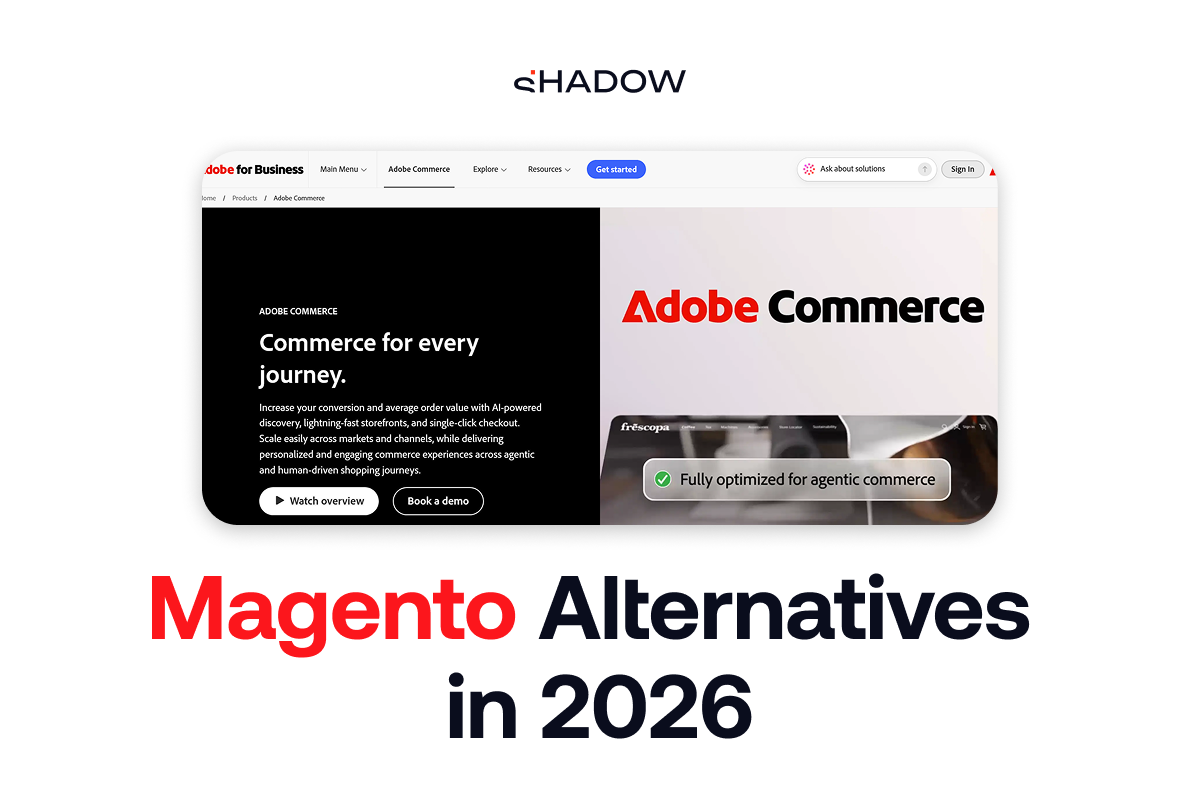
Adobe Commerce (Magento) is the right alternative when the commercetools evaluation is driven by catalog complexity or B2B requirements that SaaS platforms can't handle natively, rather than by composable architecture as a goal in itself.
Adobe Commerce offers the deepest product catalog flexibility of any platform in this guide: configurable products, bundle products, complex attribute sets, multi-website catalog sharing, and B2B workflows including negotiated pricing, purchase orders, requisition lists, and quote management.
The trade-off is implementation complexity and total cost. Adobe Commerce carries a GMV-based license fee and requires Magento-specialist developers. For organisations leaving commercetools because of engineering overhead, Adobe Commerce trades one form of complexity for another - it's the right choice when catalog capability is the requirement, not when operational simplicity is.
Strengths
- Deepest catalog flexibility: configurable, bundle, and grouped product types
- Best-in-class B2B (company accounts, negotiated pricing, purchase orders, quotes)
- Large extension ecosystem
- Headless delivery via PWA Studio or third-party front-end frameworks
Weaknesses
- High TCO: licensing plus implementation plus ongoing developer cost
- Requires Magento-specialist developers; smaller talent pool than Shopify or JavaScript ecosystems
- Innovation pace slower than SaaS alternatives
Salesforce Commerce Cloud
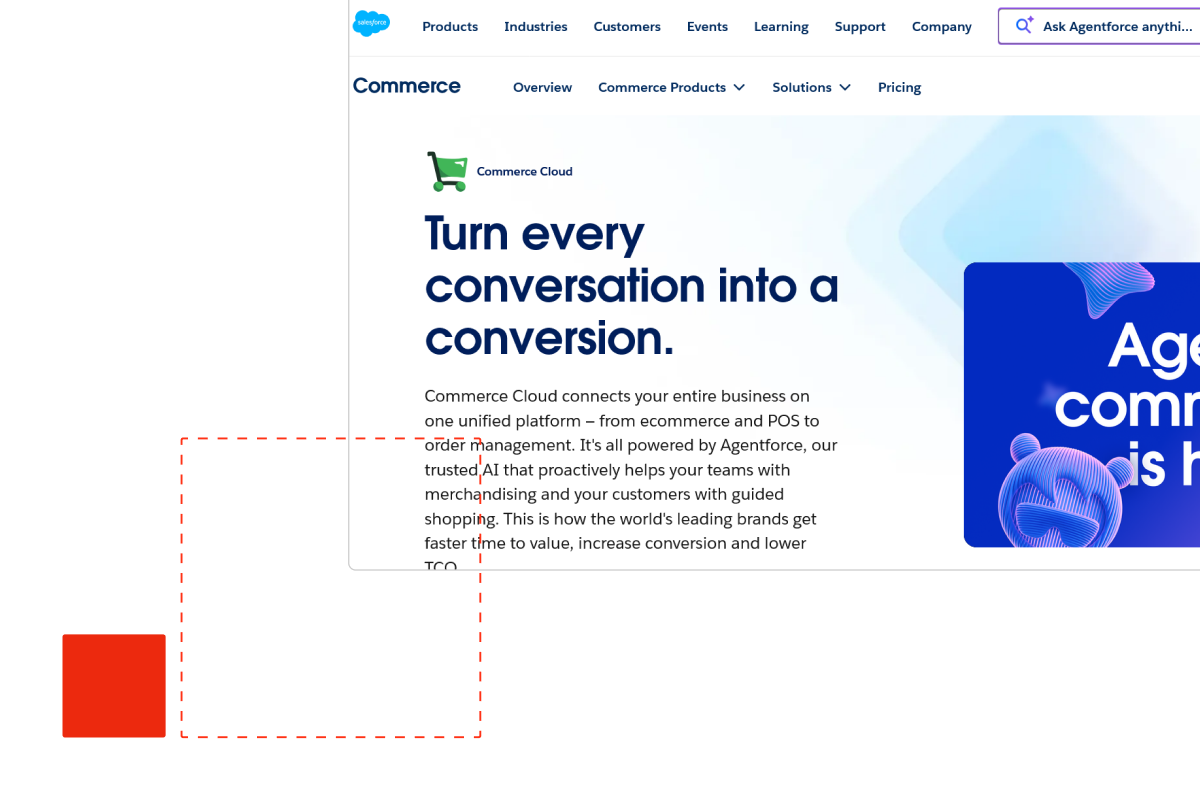
Salesforce Commerce Cloud belongs in the commercetools alternatives conversation specifically for enterprise organisations where Salesforce ecosystem integration is a hard requirement. If your commerce, marketing, and service operations are built around Salesforce CRM, Marketing Cloud, and Service Cloud, SFCC's native integration with those systems has real value.
For most organisations evaluating commercetools, SFCC is not the right destination: it carries comparable complexity, a GMV-based license at enterprise scale, and the same implementation timeline concerns that drive the commercetools evaluation in the first place. The composable storefront (formerly SFRA, now Composable Storefront PWA Kit) offers headless capability, but it's a replatforming within SFCC rather than a clean headless-first architecture.
Strengths
- Native integration with Salesforce CRM, Marketing Cloud, Service Cloud
- Enterprise-grade multi-brand and multi-region capabilities
- Composable Storefront PWA Kit for headless front-end builds
Weaknesses
- GMV-based pricing at enterprise scale is comparable to or exceeds commercetools
- Certified partner dependency for implementation
- Composable story less architecturally clean than commercetools or Elastic Path
Medusa
Medusa is an open-source Node.js commerce platform built for engineering-led teams who want the flexibility of API-first commerce without licensing cost. It covers product catalog, cart, checkout, and order management through a modular architecture - each component can be extended or replaced.
For teams coming from commercetools who want to reduce licensing cost while maintaining an API-first approach and full code ownership, Medusa is the most architecturally comparable open-source alternative. The front-end is entirely separate (the headless model), and the platform is maintained as a JavaScript/TypeScript project - the same ecosystem most front-end teams work in.
Strengths
- Free and open-source; no licensing cost
- Node.js/TypeScript architecture fits modern front-end development teams
- Modular design: extend or replace individual commerce components
- Active community with growing enterprise adoption
- Full code ownership; no vendor lock-in
Weaknesses
- Less mature than commercetools for complex enterprise requirements
- Smaller partner ecosystem
- Requires engineering resources to implement and maintain
- Self-hosted: infrastructure, security, and scaling are your responsibility
Saleor
Saleor is an open-source, GraphQL-first commerce platform. Where Medusa uses a REST-first approach with GraphQL support, Saleor was built GraphQL-native - the API design is clean, type-safe, and well-documented, making it a strong choice for engineering teams that have adopted GraphQL as their API standard.
Saleor offers both self-hosted open-source and a managed cloud deployment. The cloud option reduces the infrastructure management overhead while retaining the open-source licensing model for the core platform.
Strengths
- GraphQL-native API: clean, type-safe, well-documented
- Open-source with managed cloud option
- Active community and good front-end framework integrations
- Dashboards and admin UI included (unlike some headless-only platforms)
Weaknesses
- Less B2B feature depth than commercetools or Adobe Commerce
- Smaller enterprise reference base than commercetools
- Python/Django back-end - less familiar to Node.js-oriented teams
Shopware
Shopware is a PHP-based commerce platform with strong European market presence and a clear migration path from Magento's architecture. For organisations in the commercetools evaluation whose primary market is European and whose development team is PHP-oriented, Shopware 6 offers a credible middle path: more architectural openness than Shopify, less engineering overhead than commercetools, and a headless API mode for teams that want front-end flexibility.
Strengths
- Open-source Community Edition; no licensing cost for self-hosted
- Strong headless API mode alongside traditional storefront
- Good B2B capabilities including company accounts and rule-based pricing
- PHP architecture familiar to Magento developers
- Strong European implementation partner network
Weaknesses
- Smaller global presence than Shopify, BigCommerce, or Adobe Commerce
- Less developer adoption outside Europe
- Cloud/managed version adds cost comparable to SaaS alternatives
OroCommerce
OroCommerce is purpose-built for B2B commerce in manufacturing, distribution, and wholesale. It's the right alternative when the commercetools evaluation is primarily driven by B2B requirements - complex buyer hierarchies, negotiated contract pricing, RFQ workflows, and technical product catalog management - rather than by composable architecture.
Where commercetools handles B2B through its API (you build the B2B experience), OroCommerce provides it out of the box. The depth of B2B account management, buyer permission structures, and sales team tooling built into OroCommerce's core product is unmatched in this comparison.
Strengths
- Best-in-class B2B: complex buyer hierarchy, negotiated pricing, RFQ and quote workflows
- CRM included (OroCRM) for sales team management
- Open-source core available
- Strong for technical product catalogs (manufacturing, industrial)
Weaknesses
- Smaller market presence and partner network
- Not appropriate for DTC or hybrid DTC/B2B businesses
- Less polished storefront and design tooling
Commercetools vs Alternatives: Key Decision Factors
Composability and Architectural Control
Commercetools provides the most architecturally open composable commerce stack available. Every component - pricing, catalog, promotions, checkout, order management - is an independent service delivered via API. Nothing is bundled, nothing is opinionated about the front-end.
The relevant question is whether your organisation actually needs that level of architectural control. Most commerce scenarios don't require replacing the pricing engine or the checkout back-end with custom services. Organisations that genuinely need composable architecture at that depth are a smaller group than the MACH marketing materials suggest.
If architectural openness is the requirement, commercetools and Elastic Path are the primary options. If headless front-end flexibility with a managed back-end is the requirement, BigCommerce and Shopify Plus (via Hydrogen) deliver it with substantially less engineering overhead.
Total Cost of Ownership
Commercetools pricing is usage-based on API calls and data volume, with enterprise contracts typically starting at 50,000-150,000+/year in licensing before implementation. Implementation of a full commercetools build typically adds 300,000-1,000,000+ in agency or engineering cost.
All figures are estimates for planning purposes only. Actual costs depend on scope, agency rates, and contract terms.
Speed to Market
B2B Capabilities
Organisations with complex B2B requirements should prioritise: OroCommerce (most complete B2B out of the box), Adobe Commerce, BigCommerce Enterprise, and Shopify Plus (strong native B2B in 2026). Commercetools handles B2B via API but requires building the B2B experience rather than buying it.
Who Should Stay with Commercetools vs Who Should Switch
Stay with commercetools if:
- Your engineering team has the capacity and expertise to build and maintain a composable stack
- Your commerce requirements genuinely need component-level flexibility (custom pricing engine, custom checkout back-end)
- You're operating at a scale where the API-first architecture delivers measurable value in performance and flexibility
- You have existing commercetools investment and a functioning team - don't migrate for the sake of it
Consider switching if:
- Time-to-market is consistently constrained by the engineering overhead of the composable build
- Your engineering team is a bottleneck, not an accelerator
- The total cost of operating commercetools exceeds the value extracted from its composable architecture
- Your commerce requirements fit within what a managed SaaS platform (Shopify Plus, BigCommerce) delivers out of the box
- You're in the early stages of commercetools implementation and the scope has grown beyond original estimates
How to Choose the Right Alternative
Work through these questions in sequence:
1. Is composable architecture itself the requirement, or is headless front-end flexibility? Composable (replace any back-end component): Elastic Path or commercetools. Headless front-end with managed back-end: BigCommerce, Shopify Plus (Hydrogen), Shopware.
2. What is your engineering team's realistic capacity? Large, dedicated engineering team: composable platforms are viable. Small team or agency-dependent: managed SaaS (Shopify Plus, BigCommerce) reduces operational risk. Developer-led, open-source preference: Medusa or Saleor.
3. What is your primary B2B requirement? Complex B2B out of the box: OroCommerce, Adobe Commerce, BigCommerce Enterprise. B2B via API: commercetools, Elastic Path. Strong native B2B at reasonable cost: Shopify Plus, BigCommerce.
4. What does Year 1 total cost look like against your platform budget? Under $150,000: Shopify Plus, BigCommerce, or open-source (Medusa, Saleor). 150,000-500,000: Adobe Commerce, Shopware, Elastic Path. Above $500,000: commercetools, Salesforce Commerce Cloud.
5. What is your target time to launch? Under 6 months: Shopify Plus or BigCommerce. 6-12 months: BigCommerce, Adobe Commerce, Shopware. 12+ months: commercetools, Elastic Path.
Work with Shadow Digital
The commercetools evaluation is often where organisations realise they've been specifying architecture rather than business requirements. The right platform is the one that solves your actual problem - not the one that matches an architectural diagram.
Shadow Digital helps ecommerce brands at this decision point work through what they actually need and which platform delivers it within their engineering capacity and timeline. We build on Shopify Plus for most of our clients, but the advice starts with your requirements.
Book a strategy call to work through your platform evaluation. Or see our work to see what the right platform choice looks like in practice.
A Note on Sources
Pricing ranges in this article are estimates based on publicly available information, market reporting, and vendor documentation current at time of writing. Enterprise platform pricing is quote-based and variable - all figures are for planning purposes only. Verify current pricing and scope directly with each vendor. Implementation cost ranges reflect typical project scope from industry reporting; actual costs depend on engineering rates, scope, and timeline.
Frequently Asked Questions
What Is the Best Alternative to Commercetools?
There is no single best alternative. Elastic Path is the most architecturally comparable option for teams committed to composable commerce. Shopify Plus is the best option for teams prioritising speed and operational simplicity. BigCommerce Enterprise suits multi-storefront and mid-market requirements. Medusa or Saleor suit engineering-led teams that want open-source flexibility. The right alternative depends on why commercetools doesn't fit.
Is Commercetools Too Expensive for Mid-Market?
For most mid-market merchants, yes. The licensing cost plus the engineering investment required to build and operate a commercetools implementation typically exceeds $400,000 in Year 1. Mid-market merchants whose commerce requirements fit within a managed SaaS platform will typically find Shopify Plus or BigCommerce delivers comparable commercial capability at 20-30% of commercetools' total cost of ownership.
Can Shopify Plus Replace Commercetools?
For DTC and D2B brands whose requirements fit within Shopify's model, yes. Shopify Plus cannot replace commercetools for organisations that genuinely need composable architecture - the ability to swap back-end components, run custom pricing engines, or operate a fully decoupled MACH stack. For organisations that want headless front-end flexibility with a managed commerce back-end, Shopify Hydrogen provides a credible headless delivery model on top of Shopify's infrastructure.
What Is the Open-Source Alternative to Commercetools?
Medusa and Saleor are the strongest open-source headless commerce alternatives. Medusa uses Node.js/TypeScript and offers a modular architecture for engineering teams that want full code ownership and flexibility without licensing cost. Saleor is GraphQL-native and Python/Django-based. Both require engineering resources to implement and maintain and are not appropriate for non-technical teams.
How Long Does a Commercetools Migration Take?
Moving from commercetools to a SaaS platform (Shopify Plus, BigCommerce) typically takes 4-9 months depending on catalog complexity, integration scope, and front-end rebuild requirements. Moving from commercetools to another composable platform (Elastic Path) involves comparable scope. The front-end and integration rebuilds typically drive the timeline more than data migration.
Is BigCommerce a Composable Commerce Platform?
BigCommerce describes itself as "Open SaaS" rather than composable. It provides open APIs and a GraphQL Storefront API that enables headless front-end builds, but the back-end is a managed SaaS with less component-level flexibility than commercetools or Elastic Path. For teams that want headless front-end capability with a managed back-end rather than a fully composable stack, BigCommerce is a strong option.